

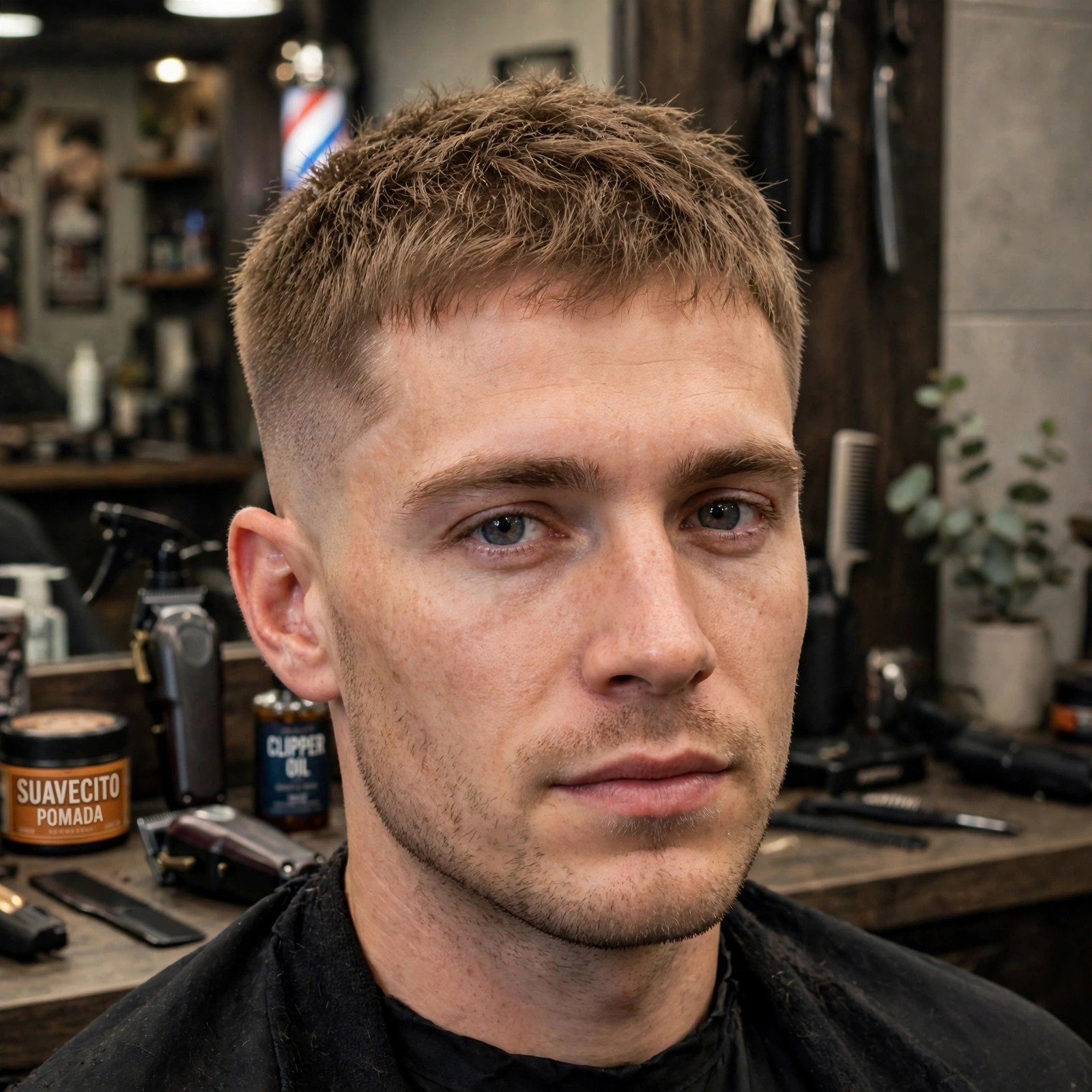
If you are looking for the best short haircuts for fine hair, the first thing to get straight is what fine hair actually is — because it is not the same problem as thin hair, and it does not need the same solution. Fine hair describes the diameter of each individual strand: your strands are narrow, soft, and light. Thin hair describes density: how many strands you have per square inch. You can have fine hair in a full, dense head of it, and you can have coarse strands that are thinning. Many men have both, but if your hair is fine and still reasonably dense, you have more options than you think — you just need cuts that create texture and movement instead of cuts that rely on weight and bulk your hair does not have.
This guide covers only short hair: roughly buzz length through to about three inches on top. For each cut below you get who it suits most, the exact lengths to ask your barber for, how to style it without weighing it down, and how often it needs maintenance. If your main issue is low density or a visible scalp, start with our guide to the best short haircuts for thin hair as well — the two guides overlap in places, but the reasoning is different, and this page is written specifically for fine strands.
Why fine hair needs a different short cut
Fine strands behave differently in three ways that should shape your haircut choice.
First, fine hair has no natural body. Each strand is light and flexible, so longer fine hair tends to fall flat against the head and separate into stringy sections. Short length is your friend here: the shorter the strand, the less weight pulls it down, and the more it can stand up and create the impression of fullness.
Second, fine hair shows product mistakes fast. A heavy pomade, oil, or wax that would disappear into coarse hair will coat fine strands, clump them together, and make the hair look thinner and greasier by midday. Product type and amount matter more for fine hair than for any other hair type.
Third, fine hair shows the scalp and the cut’s mistakes sooner. Because the strands are narrow, they cover less. A blunt, one-length cut can look wispy at the edges, and an uneven grow-out shows quickly. Texture — point cutting, choppy ends, varied short lengths — scatters light and makes the hair read as fuller than a smooth, flat surface does.
The strategy, in one line: keep it short, keep it textured, keep product light and matte, and keep the sides clean so the top looks deliberate.
The best short haircuts for fine hair, cut by cut
1. Textured crop with a choppy fringe
The textured crop is the strongest all-round choice for fine hair. The top is kept at roughly one to two inches, heavily point-cut so the ends are uneven rather than blunt, and worn forward into a short fringe. That choppiness is exactly what fine hair needs: instead of lying in flat sheets, the hair breaks into small sections that overlap and create shadow and depth, which the eye reads as thickness.
Ask your barber for: one to two inches on top, point-cut for maximum texture, a short fringe worn forward with no hard straight line, and a mid fade or tapered sides. Use the exact words: “Textured crop, lots of point cutting on top, keep the fringe short and broken up.”
Style it on dry or nearly dry hair. Work a pea-sized amount of matte clay or light paste through your palms until it disappears, then push the top forward and pinch small sections at the front to separate them. Never apply product to wet fine hair — water plus product weighs it down before you start. Expect under two minutes. Upkeep is every three to four weeks; once the fringe gets long enough to lie flat and heavy, the texture effect is lost.
This cut suits fine hair that is straight or slightly wavy, and it works across most face shapes. It is also forgiving if your hairline is not perfectly even, because the forward fringe covers the front edge.
2. Short French crop with a low fade
A close cousin of the textured crop, the French crop keeps the top shorter — about half an inch to one and a half inches — with a short, straight-ish fringe and a low fade. For fine hair, the shorter top is an advantage: at this length, fine strands stand more upright and look denser than they do when given extra length to flop over.
Ask your barber for: half an inch to one and a half inches on top, worn forward, a short fringe softened with point cutting so it does not form one thin line, and a low fade that blends below the temple.
Style with a fingertip of matte product pushed forward, or wear it product-free on days when the cut is fresh. Upkeep is every two to three weeks, because the fringe length is precise and fine hair shows a messy fringe quickly. This cut suits men who want the lowest-effort version of the crop, and it pairs well with a strong jaw or a shorter face.
3. Crew cut with texture on top
The classic crew cut — short on top, slightly longer at the front, following the head shape — works for fine hair when your barber adds texture instead of cutting it as one flat guard length. A single-length crew can make fine hair look like a smooth cap. A textured crew, cut with scissors or a guard plus point cutting at the front, breaks that surface up.
Ask your barber for: a number 5 to 7 guard equivalent on top (roughly five-eighths to seven-eighths of an inch), slightly longer toward the front, texture through the front section, and a low fade or taper at the back and sides.
Styling is minimal: most men wear it as it dries. If the front lies too flat, a tiny amount of light styling cream or a volumising mousse worked in while damp and then blow-dried forward can lift it. Upkeep is every two to three weeks.
The crew cut suits fine hair in professional settings and men who want almost no morning routine. If your fine hair is also thinning at the crown, keep the top at the shorter end of this range so there is less contrast between areas.
4. Buzz cut with a fade
A buzz cut removes the problem entirely: when every strand is a quarter to half an inch long, fineness stops mattering because no strand is long enough to lie flat, separate, or look stringy. It is the most honest cut on this list and, for many men with fine hair, the most flattering — the uniform short length reads as clean and intentional.
Ask your barber for: a number 3 to 5 guard on top, a mid fade blended smoothly at the sides, and the hairline cleaned up naturally rather than squared off sharply. Our clipper guard guidance applies here as elsewhere: one guard number is one-eighth of an inch, so a number 4 leaves about half an inch.
There is no styling step and no product cost. Upkeep is every two to three weeks, or weekly at home for the top if you own clippers, leaving the fade to your barber. This cut suits fine hair at any density, men who train or swim often, and anyone tired of fighting flat hair every morning. The trade-off is that it shows your head shape and hairline completely, so if either is a concern, choose the crop instead.
5. Short quiff with light volume — with care
A quiff can work on fine hair, but only in its short, soft form. Fine hair will not support a tall, sculpted quiff; it will collapse by midday and look thinner for trying. A short quiff — two to three inches on top, longer at the front, styled up and slightly back with light products — uses blow-drying and a matte finish to create lift that fine hair can actually hold.
Ask your barber for: two to three inches on top with the front longest, texture through the ends, and a mid fade or taper that keeps the sides close so the contrast makes the top look fuller.
Style it on damp hair: apply a small amount of volumising mousse or pre-styler, blow-dry the front up and back using your fingers, then finish with a pea-sized amount of light matte paste — not a wet-look or oil-based product. If you prefer a neater finish, our guide to the best pomade for men’s short hair explains hold and shine levels; choose a light-hold, low-shine option and use half what the tin suggests. Expect three to four minutes. Upkeep is every three to four weeks.
This cut suits fine hair that still has good density at the front. If your hairline is receding, the crop usually flatters more, because a quiff draws the eye to the front corners.
6. Short side part with a taper
The side part gives fine hair structure without asking it for volume. At one and a half to two and a half inches on top, fine hair is long enough to part and lie in a deliberate direction, and the neat, combed shape reads as polished rather than flat — provided you keep the product light and the sides tapered close.
Ask your barber for: a natural part where your hair wants to fall, one and a half to two and a half inches on top, scissor-cut or tapered sides kept close, and enough length at the front corner for the part to hold.
Style it by parting the hair while damp, applying a light water-based cream or a very small amount of light pomade, and combing the top to the side. Let it dry in place rather than blow-drying it into stiffness. Upkeep is every three to five weeks; tapered sides grow out more gracefully than fades, which suits fine hair because the grow-out looks softer.
This cut suits fine hair in formal or client-facing jobs and older men whose fine hair is going gray — gray fine hair styled neatly reads as distinguished, while gray fine hair left wispy reads as untidy.
Fine hair versus thin hair: which guide are you?
Because these two get confused constantly, here is the quick test. Take a single strand between your fingers. If you can barely feel it, your hair is fine. Now look at your scalp in normal light: if you can easily see scalp through the hair across the top — not just at a parting — your density is on the thin side. Fine and dense: follow this guide and prioritise texture and light product. Fine and thin: follow this guide’s shorter cuts (French crop, buzz, short crew) and also use the density advice in the thin-hair guide. Coarse but thin: the thin-hair guide matters more than this one, because coverage, not strand behaviour, is your main issue.
Styling fine short hair without weighing it down
Product rules for fine hair are simple and strict. Choose matte, dry-finish products: matte clay, light paste, styling powder, and volumising mousse are the useful categories. Avoid oils, high-shine pomades, heavy waxes, and anything marketed as “wet look” — shine plus weight is the exact combination that makes fine hair clump and look sparse. For a full overview of product types and where each fits, see our hub guide to the best hair products for men’s short hairstyles.
Use less than you think. A pea-sized amount is a real measurement for fine hair, not a figure of speech. Emulsify it fully between your palms, apply it to dry hair from the back forward, and stop as soon as the shape holds — the second application is where fine hair goes greasy.
On price, most light matte products sit in the budget band (under about $12), the mid band (about $12 to $22), or the premium band (above about $22). Owner feedback consistently suggests that for fine hair, formulation matters more than price tier: a light, dry clay in the budget band will outperform a heavy premium pomade on fine strands every time. Wash product out properly — fine hair accumulates build-up quickly, and a clarifying wash once a week or so keeps it from going limp if you use product daily.
Two technique points help more than any product. First, blow-drying matters for fine hair: drying damp hair in the direction you want it to sit adds lift that air-drying rarely gives. Second, do not touch your hair through the day. Every touch transfers oil and presses the texture flat, and fine hair does not spring back.
What to avoid with fine hair
Avoid growing the top long in the hope of more coverage — longer fine hair separates and shows more scalp, not less. Avoid blunt, one-length cuts with no texture; they create a smooth surface that reads as thin. Avoid heavy, shiny products and over-applying light ones. Avoid very long fringes, which lie flat and stringy. Avoid a hard, razor-sharp part or hairline if your density is also low, because the contrast draws the eye to the scalp edge. Finally, avoid stretching barber visits too far: fine hair loses its shape faster than coarse hair, and a textured cut that has grown out for six weeks looks wispy even if it looked full at three.
Upkeep schedule at a glance
Buzz cut with fade: every 2 to 3 weeks. Short French crop: every 2 to 3 weeks. Crew cut: every 2 to 3 weeks. Textured crop: every 3 to 4 weeks. Short quiff: every 3 to 4 weeks. Side part with taper: every 3 to 5 weeks. Across all of them, the pattern is the same: fine hair needs slightly more frequent trims than coarse hair to keep its texture working, and a short edge clean-up between full cuts can stretch any of these by about a week.
Frequently asked questions
What is the best short haircut for fine hair?
For most men, the textured crop is the best all-round choice: the point-cut texture creates the appearance of fullness, the short length stops fine strands lying flat, and it takes under two minutes to style with a small amount of matte product. The buzz cut with a fade is the best zero-styling alternative.
Is fine hair the same as thin hair?
No. Fine describes the width of each strand; thin describes how many strands you have. You can have fine hair that is dense, and coarse hair that is thin. The distinction matters because fine hair mainly needs texture and light product, while thin hair mainly needs coverage strategies and shorter, more uniform lengths.
Should men with fine hair use pomade?
Only a light-hold, low-shine, water-based pomade, and only in a very small amount — and for most fine-hair cuts, a matte clay or light paste is a better default. Heavy or high-shine pomades coat fine strands, clump them together, and make the hair look thinner and greasy.
Does a buzz cut make fine hair look better?
Usually, yes. At buzz length, no strand is long enough to lie flat or separate, so fineness stops being visible and the cut reads as clean and uniform. It is the lowest-maintenance option on this list, with the trade-off that it fully shows your head shape and hairline.
How often should men with fine hair get a haircut?
Every two to four weeks for most short cuts — slightly more often than men with coarse hair, because fine hair loses its textured shape faster as it grows. If the fringe starts lying flat or the top starts separating into sections, you are overdue.

