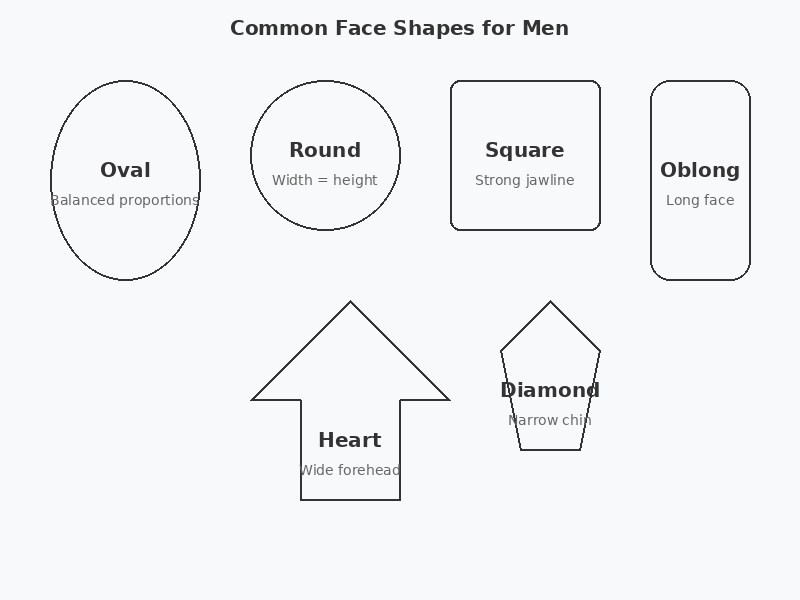

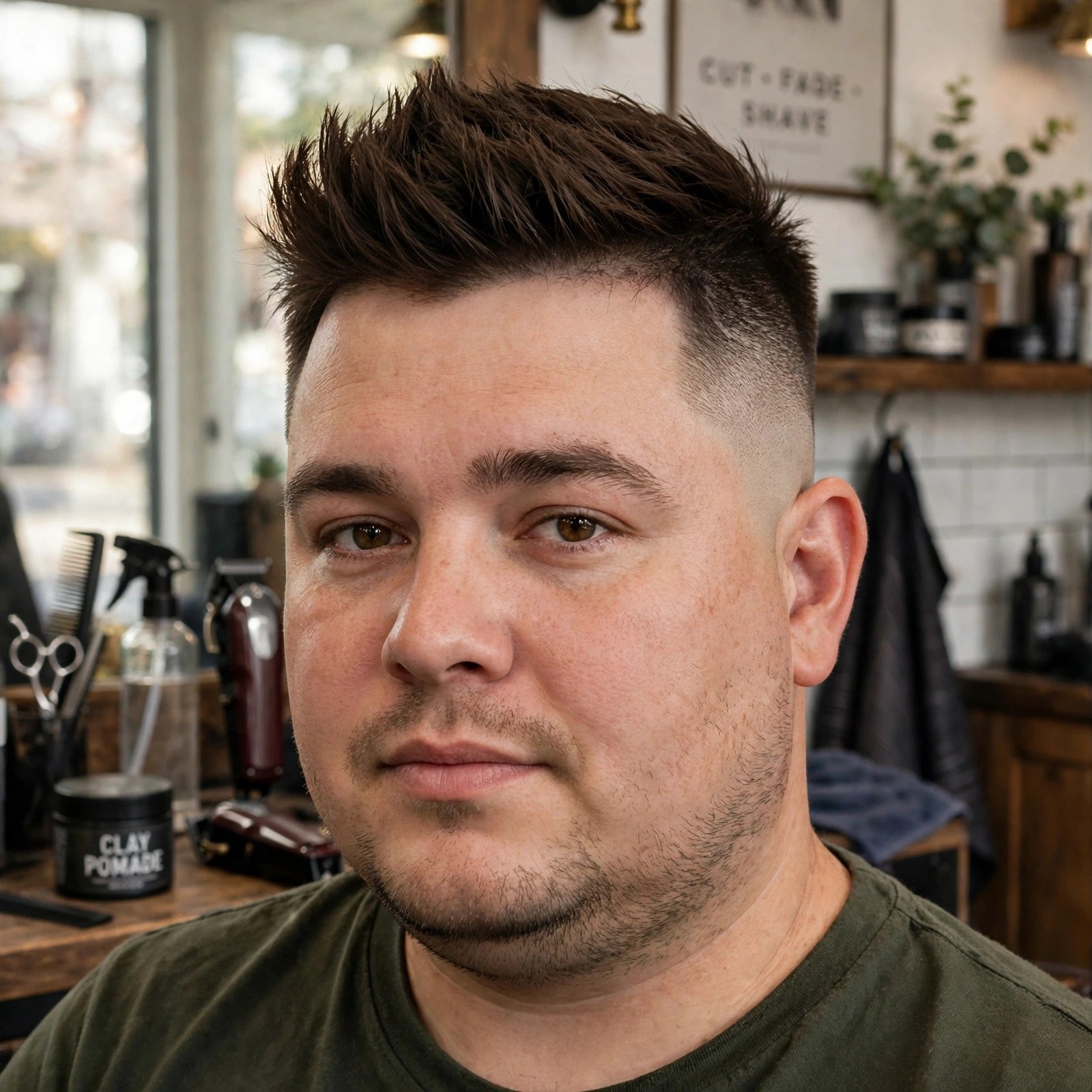
If you are looking for the best short haircuts for round faces, the goal is not to hide your face shape — it is to change the proportions around it. A round face is roughly as wide as it is long, with soft angles, fuller cheeks, and no sharp jaw corner to break up the outline. The wrong short cut makes that outline wider and shorter. The right one adds height on top, keeps the sides tight and close, and introduces at least one clear angle — a part line, an angled fringe, or a squared-off hairline — so the face reads longer and more defined than it actually is.
This guide is specific to round faces. If you are still working out your shape, start with our general guide to the best short haircuts by face shape, which compares round, square, oval, long, and heart shapes side by side. Come back here once you know yours is round, because every cut, guard number, and styling step below is chosen for one job: length up top, no width at the sides, and nothing round sitting on top of a round face.
How to tell if you actually have a round face
Face-shape advice only works if the diagnosis is right, and a lot of men guess wrong in the mirror because a grown-out cut adds width that is not really face shape. Check these three signs with your hair pushed back and no product in it.
Your face length and cheek width are close to equal. Measure, do not eyeball it if you can: hairline to chin versus cheekbone to cheekbone. If those two numbers are within about half an inch of each other, that is the core round-face pattern.
Your jaw has no hard corner. Run your eye from ear to chin. On a square face there is a visible angle at the back of the jaw. On a round face the line curves continuously, and the chin itself is rounded rather than pointed or flat.
Your cheeks are the widest, fullest part. Cheekbones are not sharp and prominent the way they are on a heart or diamond shape — the fullness sits lower and softer, which is exactly why side width from hair is so costly: it adds bulk at the point that is already widest.
If two of the three are true, treat your face as round for haircut purposes. If only one is true, you are probably oval or square with a soft jaw, and the general face-shape guide above is the safer starting point — although the tighter-sides advice below will still do you no harm.
The 3 rules every round-face cut has to follow
Every cut in the list that follows obeys the same three rules. If a style you like breaks two of them, it is almost certainly the wrong style for a round face, no matter how good it looks on the model.
1. Add height on top, not length everywhere
Vertical length is what lengthens the face visually. That means roughly 2 to 4 inches on top for most of the cuts below, styled up or up-and-back rather than flat or forward-down. A completely flat top on a round face wastes the one direction you can use for free. The exception is the textured crop, covered below, which earns its place through an angled fringe instead of height — and even there, the fringe works because the sides are taken especially tight.
2. Keep the sides tight, short, and close to the head
Width at the sides is the single biggest round-face mistake. Hair that sticks out above the ears, a low taper that leaves bulk at the parietal ridge, or a scissor-cut side left long and puffy will widen the face at its widest point. Ask for a fade or a tight taper on the sides for almost every cut on this page. Where a fade sits matters too — our comparison of low fade vs mid fade explains the trade-off, but the short version for round faces is this: a mid or high fade removes width higher up and usually flatters more than a low fade, which preserves a band of length exactly where you least want it.
3. Create at least one angle
Round plus round looks rounder. A hard or soft part line, a fringe cut on a slight diagonal, a squared temple, or texture that breaks the top into separated pieces rather than one smooth dome — any one of these interrupts the circle. A smooth, rounded fringe that follows the hairline in an arc is the one detail to refuse, even if everything else about the cut is right.
The best short haircuts for round faces, cut by cut
The six cuts below are ordered from most forgiving to most demanding. Each one lists who it suits, the lengths to ask for, and how it grows out, because a cut that only looks right in week one is not a good recommendation.
1. Short quiff with a mid fade — the most reliable all-rounder
Who it suits: Most round-faced men, especially straight or wavy hair of medium thickness. This is the default recommendation if you do not know where to start.
The quiff is built for this face shape: length at the front is lifted up and slightly back, which adds the vertical line a round face needs, while the mid fade strips width from the sides in one move. Keep the back and crown shorter than the front so the height is concentrated where it lengthens, not spread into a uniform dome.
How to ask: 3 to 4 inches at the front, graduating to about 2 inches at the crown; mid fade on the sides and back, starting around a #1 and blending up; texture through the top so it lifts instead of lying in a block. The full word-for-word approach is in the script section below.
Styling: Blow-dry the front up with your fingers or a vent brush while it is damp — this step does more than any product — then work in a pea-sized amount of matte paste or clay once dry. Skip high-shine products here; shine on a lifted front reads as roundness.
Upkeep: Barber every 3 weeks. The fade softens first, then the front loses its lift as it passes 4 inches.
2. Side part with a taper fade — the sharp, professional option
Who it suits: Men who need a neat, work-safe cut, and men with straight or slightly wavy hair that will hold a part without a fight.
The part line is the angle. A defined part — natural or barber-sharpened — cuts a straight line across the top of the head that the eye reads as structure, and sweeping the longer side up and over adds modest height without any spiking or drama. The taper fade underneath keeps the outline close without the stark contrast of a skin fade.
How to ask: 2.5 to 3.5 inches on top, longer on the part side; taper fade on the sides, low-to-mid, taken tight around the ears; keep your natural part unless your barber suggests sharpening it, and ask for the top to be scissor-cut, not clippered flat. If you have never asked for a taper fade before, our guide on how to ask your barber for a taper fade walks through the exact wording and the variations.
Styling: Comb the part in while damp, sweep the top over with a little lift at the front, and finish with a small amount of low-shine paste or a water-based pomade if your hair needs the control. Fine hair should stay with paste — pomade weight collapses the lift by midday.
Upkeep: Every 3 to 4 weeks. This is the most forgiving grow-out on the list, because a taper softens rather than disappearing.
3. Textured crop with an angled fringe — the modern, low-styling option
Who it suits: Men with straight or wavy hair who want a current look with almost no morning routine, and men whose hair will not hold a quiff up.
This is the exception that proves the height rule, so the details matter. A crop worn forward with a blunt, rounded fringe will make a round face look rounder — do not accept that version. The round-face version has three adjustments: the sides are taken to a high or mid-high fade so the silhouette is narrow, the top is heavily textured so it sits as broken pieces rather than a smooth cap, and the fringe is cut short and on a slight angle or left choppy and uneven rather than arced.
How to ask: 1.5 to 2.5 inches on top, point-cut for texture; high or mid fade on the sides; fringe short, choppy, and slightly asymmetric — say that last part out loud, because a neat arc is the barber’s default.
Styling: A fingertip of matte clay or texture paste pushed forward and pinched into pieces on dry hair. Sixty seconds, no dryer needed.
Upkeep: Every 2 to 3 weeks. The fringe length is the whole look, and it grows past the useful point quickly.
4. Longer crew cut with skin-tapered sides — the low-maintenance pick
Who it suits: Men who want the shortest routine on this page, men with thick or coarse hair, and men who play sport or wear helmets and hats daily.
A classic one-length crew cut does a round face no favours, because it follows the head’s curve exactly. The adjusted version keeps a clear step between top and sides: noticeably longer on top — a #5 or #6 guard, or scissor-cut to about an inch — left longest at the front so it can be pushed up a fraction, with the sides skin-tapered or faded so there is a visible contrast line. That contrast is what stops it reading as a dome.
How to ask: #5 or #6 on top, longer at the front than the crown; skin taper or a #0-to-#1 fade on the sides; squared-off temples to add the angle. Do not let the top be taken to the same curve as the sides.
Styling: Optional. A tiny amount of matte product pushed up at the front on days you want the extra height; nothing at all the rest of the time.
Upkeep: Every 2 to 3 weeks for the sides; the top itself could go 4, which is why men often book a sides-only tidy-up in between.
5. Short faux hawk with faded sides — the high-impact option
Who it suits: Younger round-faced men, or anyone who wants a deliberate, edgier statement and is willing to style it daily.
Nothing lengthens a face like a central strip of height with both sides stripped to skin or near it. The short, wide, soft version of the faux hawk works — the extreme spiked version is a different hairstyle and dates quickly. Keep the strip wide enough to look intentional (roughly the width between the outer corners of your eyes) and the height moderate.
How to ask: 2.5 to 3.5 inches along the centre strip, textured; high skin fade on the sides; gradual blend from strip to fade rather than a disconnected undercut line, which can look harsh as it grows.
Styling: This one needs product every day — a strong matte clay, applied to dry hair, pushed up and slightly together along the strip. If you will not style daily, choose the quiff instead; an unstyled faux hawk collapses into exactly the wide, flat shape you are trying to avoid.
Upkeep: Every 2 weeks. High skin fades show regrowth fastest, and this cut depends on the contrast.
6. Buzz cut with a fade and a longer top — the honest cautionary option
Who it suits: Men set on a buzz for practicality, with the important warning that follows.
A uniform buzz cut is one of the weakest choices for a round face: it traces the skull’s outline, adds no height, creates no angle, and removes every tool the other cuts use. If you want the buzz-cut life anyway, the faded version is the workable compromise — a #4 or #5 on top, a #0 or #1 fade on the sides, and a lined-up, squared hairline. The top-to-side contrast and the straight hairline do the small amount of lengthening that is available at this length. Go in expecting a practical cut that is neutral for your face shape, not one that flatters it — that honesty is worth more than pretending any buzz sharpens a jaw.
How to ask: #4 or #5 on top, faded to #0 or skin on the sides, hairline squared at the temples, not rounded.
Styling: None. Sunscreen on the scalp for the first weeks if you have gone much shorter than usual.
Upkeep: Every 2 weeks, or at home if you own clippers and a second mirror for the fade — most men find the fade itself is the part worth paying the barber for.
At a glance: all six cuts compared
| Cut | Top length | Sides | Best for | Barber visit |
|---|---|---|---|---|
| Short quiff, mid fade | 3–4 in at front | Mid fade, #1 up | Most men; straight or wavy hair | Every 3 weeks |
| Side part, taper fade | 2.5–3.5 in | Low-to-mid taper fade | Professional settings; straight hair | Every 3–4 weeks |
| Textured crop, angled fringe | 1.5–2.5 in | High or mid fade | Low styling effort; modern look | Every 2–3 weeks |
| Longer crew, skin taper | About 1 in (#5–#6) | Skin taper or #0–#1 fade | Thick hair; sport; minimal routine | Every 2–3 weeks |
| Short faux hawk | 2.5–3.5 in centre | High skin fade | Maximum lengthening; daily stylers | Every 2 weeks |
| Buzz with fade | #4–#5 guard | #0–#1 fade | Practicality first | Every 2 weeks |
Adjusting for your hair type
The cut list assumes medium straight-to-wavy hair. Adjust as follows if yours is different — the face-shape rules stay the same, only the execution changes.
Thick or coarse hair. Your advantage is natural volume; your risk is bulk. Ask for thinning and texture through the top of a quiff or faux hawk so the height is lift, not mass, and never accept scissor-cut sides left at comb length — thick sides push straight out. The crew cut and the quiff are your strongest options.
Fine or thin hair. Height is harder to hold and scalp show-through punishes clumping. Favour the side part and the longer crew, keep product lightweight and matte, apply it to fully dry hair, and avoid wet-look finishes, which separate fine hair into strings. Very short faded sides are still right for you — they make the top look denser by contrast.
Curly hair. Curls add width as they dry and spring up, so have the cut shaped dry, keep the sides faded rather than scissor-blended (blend lines disappear into curl and leave bulk), and take the top a half-inch longer than the table suggests to allow for shrinkage. The textured crop and the longer crew translate best; a quiff works on looser curl patterns if you are willing to blow-dry.
Wavy hair. You have the easiest time on this page — wave gives the quiff and side part their texture for free. Watch only the sides: wave at scissor length curls outward at the ridge, so keep the fade instruction firm.
Receding hairline. Do not try to compensate with a long fringe swept forward — on a round face that trades one problem for a worse one. The longer crew and a short textured crop with the fringe kept short and choppy are the honest options, and keeping the sides tight matters even more, because width plus recession is the combination that reads oldest.
Exactly what to say to your barber
Scripts remove the guesswork. Use the quiff script as the base and swap the bracketed parts for the other cuts.
“I’m going for a short quiff. About three to four inches at the front, shorter towards the crown, with texture through the top so it lifts. Mid fade on the sides and back, starting around a number one. My face is round, so I want height on top and the sides kept tight — no length left out over the ears. Square the temples off, please.”
Three follow-ups worth having ready. If the barber suggests leaving the sides scissor-cut for a softer look, that softness is width — hold the fade. If you are shown a fringe, check it is not arced before the cut starts. And bring a photo of the cut on a man with a similar face shape, not just any photo of the cut: the same quiff on a long face is a different proposition, and a good barber will adjust the moment they see the shape you are working with.
Daily styling routine for round-face cuts
Whatever cut you chose, the morning routine follows the same order, and the order is the point.
- Start damp, not wet. After a shower, towel-dry until the hair is damp. Product on soaking hair loses half its hold and adds shine you do not want.
- Dry for height first. For a quiff, faux hawk, or side part, blow-dry in the direction of the finished style — up at the front, up and over for a part — using fingers or a vent brush. This is where the lengthening happens. Crop and crew wearers can skip the dryer.
- Product second, pea-sized, matte. Emulsify it fully between your palms, work it back to front so the fringe gets only what is left, and pinch texture into the top rather than smoothing it down flat.
- Check the profile, not just the front. Turn side-on in the mirror. If the silhouette is widest at the sides rather than tallest at the top, the sides have grown out or the top has been flattened — that is your signal the cut needs a tidy-up, not more product.
The mistakes that make a round face look rounder
Growing the sides out between visits. Short cuts lose their face-shape benefit from the sides first. A two-minute check: if hair over the ears is long enough to push outward, you are past due.
A rounded fringe. Covered above because it is that common. Arc-shaped fringes mirror the face’s curve. Choppy, short, or slightly angled — those are the only three acceptable shapes.
One length all over. Any cut where the top and sides follow the same curve — a uniform buzz, a classic bowl-like crop, a Caesar cut at one length — traces the round outline instead of changing it. Contrast between top and sides is non-negotiable.
Flat styling on a height cut. A quiff combed flat is worse than a crew cut worn honestly, because you are paying the upkeep of the longer top for none of the lengthening. If your mornings do not include two minutes of drying, choose the crop or the crew from the start.
Facial hair that widens the jaw. Haircut advice ends at the hairline, but one note earns its place: a beard trimmed round under the chin extends the face’s curve downward. A beard with a straighter, slightly squared bottom line and faded sides works with these cuts instead of against them. Ask your barber to factor it in — most will adjust the fade height to suit the beard without being asked twice.
Frequently Asked Questions
What is the best short haircut for a round face?
For most men, a short quiff with a mid fade: it adds height at the front, removes width at the sides, and suits straight and wavy hair with a three-week upkeep cycle. If you need a professional finish, choose the side part with a taper fade instead; if you will not style daily, choose the textured crop with an angled fringe or the longer crew cut.
Should men with round faces get a fade?
Yes, in most cases — a fade is the easiest way to remove side width, which is the main round-face problem. A mid or high fade usually flatters more than a low fade, because a low fade leaves a band of length at the widest part of the face. A taper fade is the softer alternative if you want a classic rather than a sharp finish.
Is a buzz cut bad for a round face?
A uniform buzz cut is one of the weakest choices, because it follows the skull’s round outline and adds no height or angle. A buzz with a fade — a #4 or #5 on top faded to a #0 or #1 on the sides, with a squared hairline — is a workable compromise for men who want the practicality, but it should be chosen as a neutral, practical cut, not a flattering one.
How long should the top be for a round face?
For height-based cuts such as a quiff or side part, roughly 2.5 to 4 inches, longest at the front and shorter at the crown, so the lift concentrates where it lengthens the face. For a textured crop, 1.5 to 2.5 inches is enough because the angled fringe and tight sides do the work instead of height.
What hairstyles should round-faced men avoid?
Avoid anything that adds width or mirrors the curve: one-length cuts, rounded or bowl-shaped fringes, long scissor-cut sides that puff out over the ears, centre parts on flat tops, and very flat styling with no lift. Also be cautious with heavy, shiny products, which emphasise roundness in the silhouette.
Does growing a beard help a round face?
It can, if it is shaped for it: a beard with faded, tapered sides and a straighter bottom line adds the angle and downward length a round face lacks. A full, round-trimmed beard does the opposite and widens the lower face. The haircut still matters more — beard shaping supports the three rules above rather than replacing them.
The short version
Best short haircuts for round faces all do the same three things: height on top, tight faded or tapered sides, and at least one real angle. Start with the short quiff and mid fade if you want the surest result, the side part if you need it professional, and the angled-fringe crop or longer crew if your mornings are short. Refuse the rounded fringe and the grown-out sides, keep the three-week barber cycle, and the cut will keep doing the lengthening work for you every day between visits.