
If you are searching for how to style thick short hair, the cut is probably not your main problem — the morning is. Thick hair looks sharp leaving the barber, then puffs out at the sides by day three, sits heavy and flat on top by week two, and seems to need more and more product to do less and less. That pattern is not a lack of effort. It is what happens when a styling routine built for average hair meets hair that has more density, more strand weight, and more outward growth than average.
This guide is a complete daily system for thick short hair specifically: how often to wash, how to dry so the hair sits down instead of out, the blow-dry method that does most of the real work, how much product to use and in what order, and how the routine changes by cut — crop, quiff, crew cut, side part, and fade. It also covers the barber-side fixes, because the honest truth about thick hair is that styling can only manage what the cut leaves behind. If the weight is still in the hair, no routine fully tames it.
Why thick short hair misbehaves
Thick hair in this guide means two things together: high density (a lot of hairs per square inch) and medium-to-coarse strands. Both matter for styling, in different ways.
Density creates outward pressure. Each strand grows in its own direction. With a lot of strands, the sides of the head — especially above the ears and at the temples — push outward as soon as there is enough length to lift away from the scalp. That is the puff most men notice first, and it is why the sides, not the top, decide whether a thick-hair cut looks controlled.
Coarse strands resist direction. A thick strand is stiffer than a fine one. It holds the shape it dries in, springs back when you try to comb it somewhere new, and needs heat or product grip — not just a quick rake with your fingers — to change direction. This is also good news: once thick hair is dried into place properly, it tends to stay there.
Weight flattens the top while the sides expand. The top of thick hair is heavy, so it can look flat and lifeless even while the sides are puffing out. Men often respond by adding strong product on top, which adds more weight and makes the flatness worse. The fix is the opposite: lift at the roots while drying, then use less product than you think.
If your hair is thick and also wavy, the wave adds its own bend and volume on top of all of this — our dedicated guide to short wavy hair for men with thick hair covers that combination cut by cut. Everything in this routine still applies; just expect the sides to puff sooner and the upkeep to sit at the shorter end of every range given below.
How to style thick short hair: the daily routine
This is the core routine, in order. The whole thing takes about five minutes once it is familiar, and the order matters more than any single product in it.
Step 1 — Wash on a schedule, not every day
Thick hair rarely needs daily shampooing, and daily washing usually makes styling harder, not easier: stripped coarse strands frizz, separate, and stand up more. Most men with thick short hair do best washing with shampoo two to three times a week and rinsing with water alone — or working a small amount of conditioner through and rinsing — on the other days.
Conditioner is not optional for this hair type. It is what keeps coarse strands lying together as a surface instead of separating into individual stiff hairs. Use it every wash, keep it off the scalp itself, and give it a minute before rinsing. If your hair feels coated and heavy, the cause is usually too much product build-up rather than conditioner — a clarifying wash once every week or two resets it.
Step 2 — Towel-dry by pressing, then leave it damp
Rubbing thick hair hard with a towel roughs up the surface and encourages the sides to stand out. Press and squeeze the water out instead. You want to style from damp — hair that no longer drips but is still clearly wet to the touch. Product spreads evenly through damp thick hair and disappears; the same product on dry thick hair sits on the surface in patches and looks dusty or greasy by midday.
Step 3 — Pre-style while damp: direction first
Before any finishing product, push the hair into its rough final direction with your hands while it is damp: fringe forward for a crop, front up and back for a quiff, top to the side for a part. Thick hair remembers the direction it dries in far more than the direction you comb it afterwards, so this thirty seconds decides most of the result.
If you use a pre-styler — a light sea salt spray for texture, or a small amount of styling powder at the roots for lift — this is when it goes in, on damp hair for spray and on dry roots for powder. Keep amounts small; thick hair needs grip at the roots, not coating along every strand.
Step 4 — Blow-dry: the step that does the real work
For thick short hair, the blow-dryer is not an optional extra — it is the main styling tool, and product is the support act. Heat softens coarse strands so they will actually change direction, and drying sets that direction for the day.
Use medium heat and a concentrator nozzle if you have one. Work in this order:
- Sides first. Aim the airflow downward over the sides and back, pressing the hair flat with your free hand or a brush as you dry. This is the anti-puff step, and doing it first stops the sides setting in an outward position while you work on the top.
- Top in the direction of the style. For a crop, dry forwards. For a quiff, dry the front section upwards and slightly back, lifting with your fingers at the roots. For a side part, dry in the direction of the part.
- Finish with a cool blast if your dryer has one. Ten seconds of cool air helps the shape hold, especially at the front.
Dry until the hair is fully dry, not nearly dry. Thick hair that is left 10 percent damp will re-expand as that last moisture leaves unevenly, and the sides will be the first place it shows.
Step 5 — Finishing product: less than you think, in the right order
With the shape already dried in, finishing product is there to add texture and hold the surface together — not to create the shape from scratch. For most thick short cuts, a matte paste or a light-to-medium clay is the right family: enough grip for coarse strands, a dry finish that does not make density look greasy. A fingernail-sized amount is the starting dose for short hair; warm it between your palms until it is fully invisible before it touches your hair.
Apply it in this order: back first, sides second, front last. Most men do the reverse and overload the front, which is exactly where thick hair shows product first. Work the remainder through the sides with flat palms, pressing down as you go — that final press is a styling move, not just application. Then pinch and define the front and fringe with whatever is left on your fingertips.
Our guide to the best hair products for men with thick short hair goes deeper on choosing between paste, clay, and cream for this hair type, including which finishes to avoid. And if you are weighing pomade specifically, the best pomade for men’s short hair guide explains when its shine and comb-control help thick hair — mainly slicker, parted styles — and when it will simply make a crop or quiff look heavy.
Step 6 — Hands off
Every pass of your hands through thick hair during the day lifts the sides back out and separates the top. Once the routine is done, leave it. If the front drops by afternoon, reactivate with slightly damp fingertips pressed at the roots rather than adding more product.
Styling thick short hair by cut
The routine above is the base. Each common cut adjusts it slightly.
Textured crop with a fade
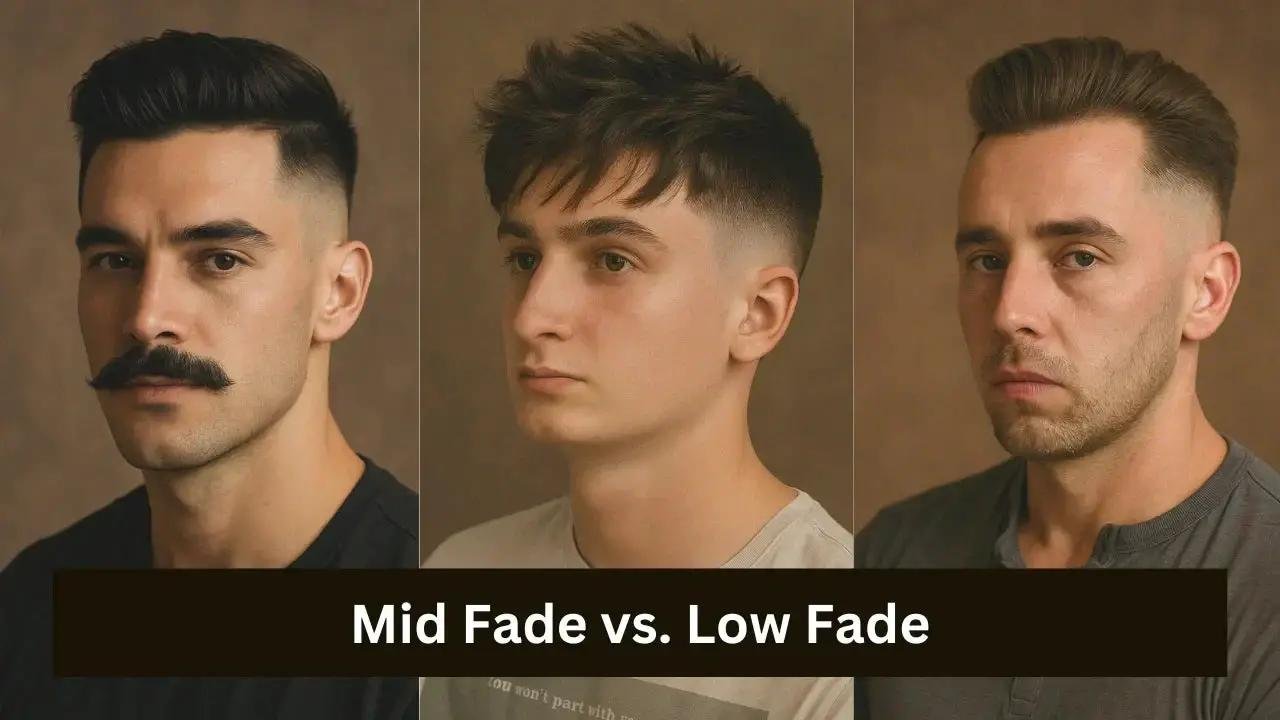
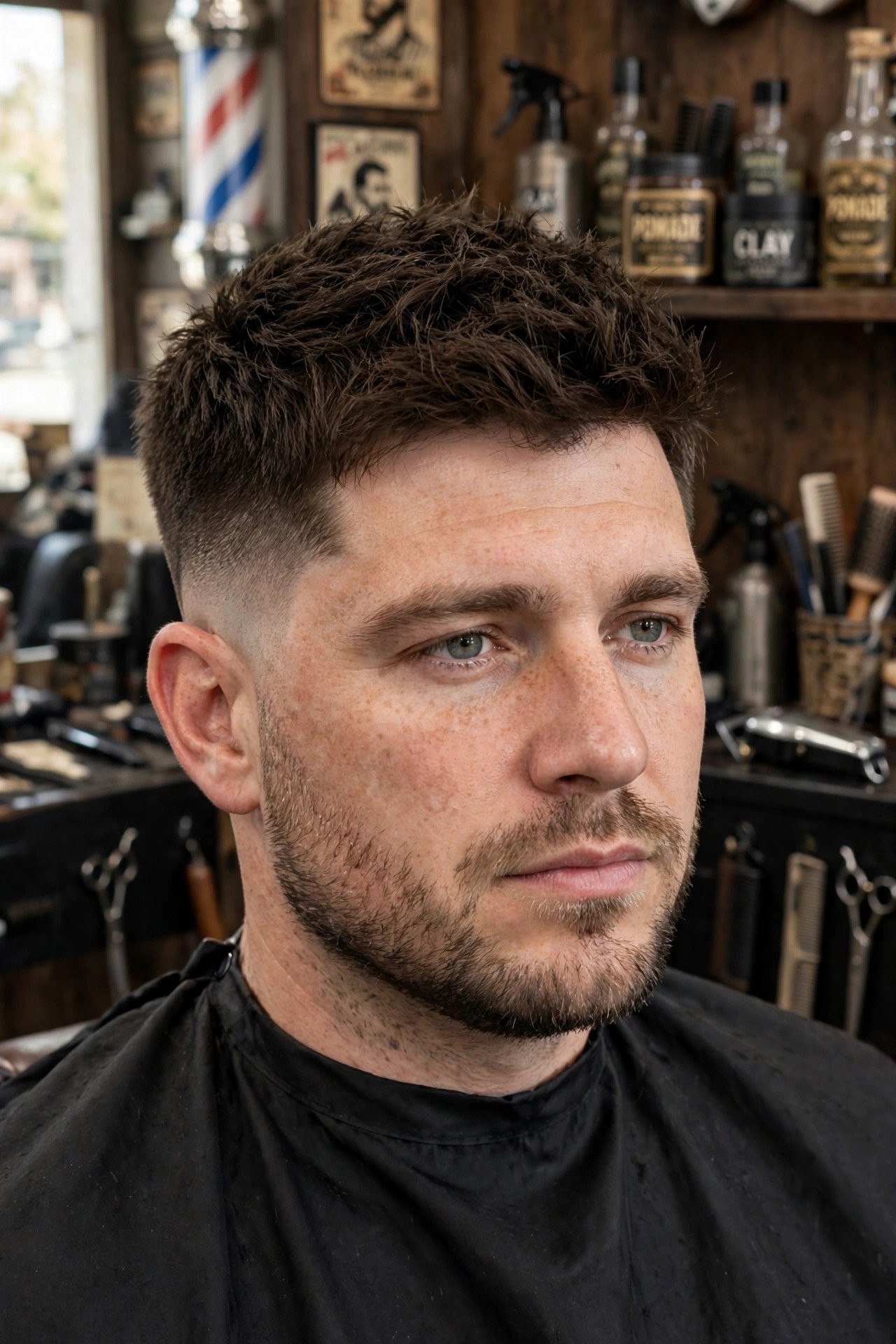
Top length is usually one to two inches, worn forward. Dry forwards and slightly down, finish with a small amount of matte paste worked front-to-back then raked forward with fingertips to break up the fringe. The fade does the side control for you, so your whole job is the top. Barber ask: textured crop, point-cut through the ends, mid fade. Upkeep: every two to three weeks before the top gets heavy.
Short quiff
Two to three inches at the front, shorter to the crown. This cut lives or dies on the blow-dry: lift the front at the roots while drying up and back, then use paste mainly at the front third. Thick hair holds a quiff with less product than fine hair needs — resist overloading it. Barber ask: weight removed through the mid-lengths so the front lifts instead of falling forward. Upkeep: about every three weeks.
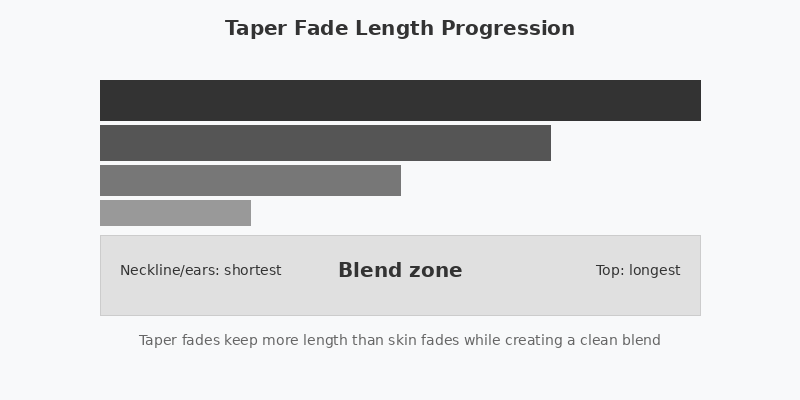
Crew cut with a taper
A number 5 to number 8 guard on top (16–25 mm), or scissor-cut to around an inch, longer at the front. Styling is minimal: dry in the direction the hair grows, and use product only if the front sticks up — a pea-sized amount of matte cream pressed down usually settles it. Barber ask: follow the head shape, leave the front a touch longer. Upkeep: three to four weeks; the taper grows out softly.
Short side part with tapered sides
About two inches on top, parted where the hair naturally splits. Dry along the part, then comb — thick hair should be parted damp and dried into the part, not combed into a new one dry. A light pomade or cream suits this cut better than a dry clay because you want the surface to lie together. Barber ask: cut the part in at the natural split and take the weight out above the ears. Upkeep: about every three weeks.
Buzz cut and skin fades
At a number 3 or 4 on top there is nothing to style, and that is the point. Your routine is scalp care and keeping the fade fresh. Thick hair shows fade regrowth fast because the density makes stubble visible within days. Upkeep: a fade refresh every two weeks keeps it sharp; the top can stretch longer than the sides.
For the full menu of cuts that suit this hair type before you settle on one, see our guide to the best short haircuts for thick hair, which covers guard lengths and face shapes in detail.
Guard lengths: what the numbers mean for thick hair
- Number 1 (3 mm) and below: skin-close, used low in fades. On thick hair, regrowth shows quickly.
- Number 2 (6 mm): the standard lower-side length — short enough to remove puff, long enough to avoid a harsh line.
- Number 3–4 (10–13 mm): buzz-cut top lengths, or the longest the sides can go before puff returns for most men.
- Number 5–8 (16–25 mm): crew-cut territory on top. At a number 8, thick hair starts to show its natural movement and width.
- Scissor-cut, one to three inches: where crops, quiffs, and side parts live. This is the range where debulking and texture matter most, because it is long enough to get heavy.
The barber fixes styling cannot replace
If you follow the routine and your hair still puffs, heavies, or will not sit down, the problem is almost always still in the cut. Three things to raise at your next appointment:
Debulking. Removing weight without removing much length. For thick hair the safest, most useful method is usually point cutting — cutting into the ends at an angle to soften them. Thinning shears have a place high on the sides and through a very heavy top, but overuse creates hundreds of short strands that escape the surface and frizz as they grow out. If your hair looks great on the day and worse from week two, over-thinning is the first suspect — ask for point cutting next time.
The puff zone. Say plainly: “It grows outwards above my ears and looks wide by week two.” A good barber will tighten the blend in that zone, suggest a fade height that removes it, or leave the sides shorter than the standard version of your cut.
The grow-out plan. Ask what the cut will look like at three weeks and whether a sides-only tidy between full cuts makes sense. For thick hair, a full cut, a cheaper sides tidy at two weeks, then a full cut again is often the pattern that keeps the shape permanently instead of in bursts.
Bringing a photo helps, with one condition: choose a man whose hair actually looks thick. The same cut photographed on fine hair promises a flatness your hair type will not deliver, and a good barber will warn you about exactly that.
Mistakes that make thick short hair harder to style
Using more product to fight volume. Volume in thick hair is a cutting problem. More product on un-debulked hair gives you greasy bulk instead of dry bulk. If a fingernail of product is not enough, you need weight out at the barber, not a stronger tin.
Skipping the blow-dry and expecting product to do its job. On coarse strands, product without heat mostly coats the surface. Five minutes of directed drying changes the hair’s direction; product then just keeps it there.
Styling on bone-dry hair. Paste and clay drag, clump, and show on dry thick hair. Damp hair distributes the same amount evenly and invisibly.
Washing every day, then fighting the frizz. Daily shampooing strips coarse hair and makes it bigger and rougher. Fewer washes plus consistent conditioner is the cheapest styling improvement most thick-haired men can make.
Growing the sides out to “blend in.” Longer sides on thick hair do not blend — they widen the head. The sides should be the shortest, tightest part of almost every thick-hair cut.
Copying a slick, wet-look finish. High-shine, slicked styles fight thick hair’s natural matte texture all day. The cuts and finishes that suit this hair type look dry, textured, and deliberate.
Second-day hair, gym mornings, and humidity
Second day: thick hair often looks better on day two, because a little natural oil helps coarse strands lie together. Refresh by dampening your hands and pressing the sides down, re-lifting the front at the roots, and adding product only if the front will not hold — usually half the normal amount.
After the gym: rinse with water, skip the shampoo unless it is a wash day, re-dry the sides down, and style as normal. Sweat left to dry in thick hair makes it feel coarser and harder to direct the next morning.
Humidity: humid air adds moisture back into coarse strands and re-expands the cut. On humid days, dry more thoroughly than usual in the morning, use a touch less cream-based product (creams can feel heavier as they absorb moisture), and expect the sides to need one flat-palm press at midday. A shorter sides length in summer is a legitimate seasonal adjustment to discuss with your barber.
For the wider comparison of every product family — paste, clay, pomade, wax, spray, and powder — our hub guide to the best hair products for men’s short hairstyles lays them out side by side.
How often does thick short hair need cutting?
More often than average hair, because every bit of growth adds width as well as length. As a working guide: skin and mid fades every two to three weeks, quiffs and side parts around three weeks, tapers and crew cuts three to four weeks. If you consistently feel the cut “goes” in week two, do not just book more full cuts — ask about the sides-tidy pattern described above. Budget-wise, on price bands for products, most pastes and clays that suit thick hair sit in the budget band (under about $12) to the mid band (about $12 to $22); format and formulation matter more for this hair type than paying for the premium band.
Frequently asked questions
How do you style thick short hair so it does not puff out?
Shorten the problem first: the sides should be faded or tightly tapered so there is no length left to puff. Then dry the sides downwards with heat while pressing them flat, before you style the top. Finish with flat palms over the sides when you apply product. If the sides still expand within days, the cut is leaving too much weight above the ears — that is a debulking conversation with your barber, not a product problem.
What is the best product for styling thick short hair?
For most short cuts on thick hair, a matte paste or a light-to-medium clay in a small amount: enough grip for coarse strands, a dry finish, and no added weight or shine. Creams suit side parts and longer short tops that need to lie together. Pomade suits slicker, parted styles but can make crops and quiffs look heavy and greasy. Product choice matters less than amount and application order — back, sides, front last.
Should you blow-dry thick short hair every day?
If you want the hair to sit in a deliberate direction, yes — the blow-dry is what changes coarse hair’s direction, and it only takes a few minutes on short hair. Use medium heat, dry the sides down first, then the top in the direction of the style, and dry fully. Men with a buzz cut or a very short crew cut are the exception; at guard lengths there is nothing to direct.
How much product should you use on thick short hair?
Start with a fingernail-sized amount for paste or clay — less than most men use. Warm it fully between your palms first. Thick hair shows excess product quickly because there is so much surface hair, and it is easy to add a second half-dose at the front if needed. Needing large amounts every day is a sign the cut is carrying too much weight.
Why does thick short hair look flat on top but wide at the sides?
Because the two zones do opposite things: the top’s strand weight presses it down, while the sides’ density pushes them out as they grow. The routine handles both at once — lift the top at the roots while blow-drying, and dry and press the sides down. A cut with weight removed through the top and tight sides makes both halves easier.
How often should men with thick short hair wash their hair?
Two to three shampoo washes a week suits most men with this hair type, with water rinses or a little conditioner on other days. Daily washing strips coarse strands, which then frizz and stand up more. Conditioner on every wash day matters — it keeps thick strands lying together instead of separating.
Does thick short hair need thinning out to style well?
It needs weight removed, carefully. Point cutting is the safest method for most thick hair. Thinning shears used sparingly can help a very heavy top and high sides, but overuse causes frizz and flyaways as the shortened strands grow out. Ask your barber which method they plan to use before they start.
The bottom line
Learning how to style thick short hair is mostly learning that the routine, not the product tin, does the work: wash less and condition consistently, set the direction while the hair is damp, blow-dry the sides down and the top into shape, then use a small amount of matte product back-to-front to hold what the dryer already built. Pair that with a cut that has the weight taken out in the right places and a two-to-four-week upkeep rhythm, and thick hair stops being the hair type that fights you and becomes what it should be — the hair type that holds any short style you ask it to.