
If you are looking for the best hair products for thick short hair, your problem is probably not a lack of volume. Thick hair has volume to spare. Your problem is control: hair that puffs out at the sides an hour after styling, a top that will not lie in the direction you put it, a fringe that springs back up, and a finish that looks either weighed down and greasy or dry and bulky at the same time. The right product for thick short hair does a different job from the product that suits fine hair. It needs enough grip to direct a lot of hair, enough weight to settle bulk without flattening the shape your barber cut in, and a finish that does not turn density into shine.
This guide is specific to short hair — roughly one to four inches on top, with shorter faded or tapered sides. At that length, thick hair behaves in a particular way: there is a lot of hair per square inch, but not much length to weigh it down naturally, so it stands out from the head, grows outward as much as downward, and overwhelms light products within a couple of hours. Everything below is framed for that combination. If you want the wider product landscape first, our hub guide to the best hair products for men’s short hairstyles covers every product family side by side; come back here when the question is specifically what works on thick hair.
What thick short hair actually needs from a product
Thick hair is dense hair. That can mean a lot of individual strands, coarse individual strands, or — most commonly — both together. On a short cut, that density creates three specific styling problems, and a good product has to solve at least two of them without making the third worse.
First, bulk. Thick short hair pushes outward. A textured crop can look like a helmet, a quiff can look like a shelf, and grown-out sides can make the whole head look wider than it is. Product alone cannot remove bulk — that is the barber’s job, covered in our guide to the best short haircuts for thick hair — but the right product settles the surface so the cut’s shape reads clearly instead of as a solid mass.
Second, direction resistance. Thick hair has a strong natural growth pattern and enough collective strength to return to it. Light creams and low-hold sprays that work perfectly on fine hair simply lose this argument by mid-morning. Thick short hair needs medium-firm to firm hold, applied to the roots, not just smoothed over the surface.
Third, product distribution. A pea-sized amount that coats fine hair evenly can disappear into one section of thick hair and leave the rest untouched. Thick hair usually needs product applied in two smaller layers rather than one larger one, worked through section by section. Several of the “this product does not work” stories from men with thick hair are really distribution stories.
What thick hair does not need is volumising product as a headline feature. Mousses, thickening sprays and most sea salt sprays are built to make hair look fuller. On genuinely thick short hair that is adding a problem, not solving one — with one narrow exception for pre-styling, covered below.
The quick answer: best hair products for thick short hair at a glance
| Product type | Hold on thick hair | Finish | Best for thick short hair when you want… | Watch out for |
|---|---|---|---|---|
| Firm clay | Strong, textured grip | Matte, dry | A textured crop, messy quiff or fringe that stays separated without puffing smooth | Drag during application; can feel dry on coarse hair if used daily at full strength |
| Firm water-based pomade | Firm, smooth control | Low to medium shine, combed | A side part, neat quiff or classic taper style that must stay directed all day | High-shine versions can look wet; too much makes thick hair look heavy |
| Paste | Medium to firm, flexible | Natural, low shine | Everyday control with a softer, reworkable finish — the best first product for most thick hair | Medium pastes can lose very coarse hair by late afternoon |
| Fibre | Strong, pliable | Matte to low shine | Short, spiky or piecey styles on very thick hair that needs pliable thickness control | Easy to over-apply; can feel waxy and build up fast |
| Matte cream (firm) | Medium | Natural, soft | Longer short tops (3–4 inches) that need settling, not sculpting | Too light for very short, very coarse hair |
| Sea salt spray (as pre-styler only) | Light on its own | Matte, gritty | Adding grip before a clay or paste on slippery, freshly washed thick hair | Useless as the only product on thick hair; adds bulk if over-sprayed |
If you only buy one product, make it a firm paste or a firm clay. Paste is the more forgiving everyday choice; clay is the stronger choice when texture and separation matter more than neatness. The head-to-head logic is the same as in our pomade vs clay for men’s short hair comparison — on thick hair, the deciding factor shifts from volume (you already have it) to control.
Firm clay: the texture choice for thick hair
Clay is built around mineral clays such as bentonite or kaolin mixed with waxes. The minerals create friction between strands, and on thick hair that friction is useful in a different way than it is on fine hair. Fine hair needs clay to create the appearance of thickness. Thick hair needs clay to organise thickness — to break a solid mass into visible pieces, so a crop reads as texture instead of bulk.
Use firm clay when your cut is a textured crop, a forward fringe, a messy quiff or any short style where the top should look separated and matte. Apply it to completely dry hair, in two pea-sized layers rather than one large scoop, working the first layer through the back and middle for control and the second through the front for separation. Because thick hair resists distribution, warm the clay fully between your palms until it turns clear before each layer.
The limits are real. Clay drags on thick, coarse hair, so rushed application leaves uneven patches. Daily use of a firm clay can leave coarse hair feeling dry by the end of the week; alternating with a paste day, or using clay only on the top, solves that for most men. And clay will not produce a neat part or a smooth sweep — if that is your style, you are in pomade territory.
Firm water-based pomade: the control choice for thick hair
Pomade is where thick hair’s resistance becomes an advantage. A firm water-based pomade has the smooth, directed hold that thick hair respects: a part stays parted, a sweep stays swept, and the surface lies flat enough that the head shape looks deliberate rather than wide. This is why classic short styles on thick hair — side parts, contour cuts, neat quiffs, slicked short backs — have always been pomade styles.
Choose water-based over oil-based for short hair. Water-based firm pomades give the control without multi-day build-up, and they rinse out with shampoo instead of needing a clarifying wash. Keep shine at low to medium: thick hair presents a large, uniform surface to the light, so high shine reads stronger on it than on fine hair and can look wet by lunchtime. Apply pomade to towel-dried, slightly damp hair, comb it into direction first, then finish with your fingers so it does not look painted on.
For a deeper breakdown of pomade types and hold levels, see our guide to the best pomade for men’s short hair, which covers firm and matte options in detail.
Thick hair is the one hair type where pomade’s main weakness on fine hair — weight — becomes a strength. The slight weight settles bulk. The caution is quantity: because thick hair tempts you to keep adding product, it is easy to cross from settled into heavy. Stop at a dime-sized amount worked through properly before you consider a second fingertip, and add that second fingertip only to the section that is still resisting.
Paste: the best starting point for most thick short hair
If clay is the texture specialist and pomade is the control specialist, paste is the all-rounder that most men with thick short hair should start with. Paste sits between the two in hold, finish and application: firmer and drier than a cream, softer and more reworkable than a firm clay, with a natural low-shine finish that neither looks wet nor dusty.
Paste suits thick hair for three practical reasons. It distributes more easily than clay, which matters when there is a lot of hair to coat. It stays reworkable, so a top that puffs out after a commute can be pushed back down with dry fingers instead of needing a full restyle. And its finish forgives density — thick hair styled with paste looks groomed without looking either slicked or dried out.
Use a firm or high-hold paste, not a soft styling paste. Apply a pea-to-dime-sized amount to dry or barely damp hair, work it root to tip from the back forward, then shape. On very coarse thick hair, paste alone may soften by late afternoon; that is the signal to move up to clay for texture styles or firm pomade for neat styles, not to double the amount of paste.
Fibre: strong, pliable control for very short, very thick hair
Fibre products are thick, waxy and highly concentrated, designed to bind strands together with strong, pliable hold. On very thick short hair — a short crop, a spiky top, a piecey fringe at one to two inches — fibre can do what clay does with a little more cohesion, holding sections together as units rather than separating every strand.
It is also the easiest product on this list to misuse on thick hair. Fibre is so concentrated that a large scoop creates a waxy coating that looks dull and feels heavy, and build-up arrives fast because thick hair holds onto product at the roots. Use less than you think — a small pea — emulsify it completely, and shampoo thoroughly on wash days. Fibre is a specialist tool for short, defined styles, not a daily default for longer short tops.
What about pre-stylers, sea salt spray and mousse?
Used alone, none of these control thick short hair, and volumising products work against you. There is one legitimate use: a light pre-styler on freshly washed hair. Thick hair just after washing is often at its most slippery and puffy, and a finishing product applied straight onto it can slide and set unevenly. Two or three sprays of sea salt spray, or a small amount of matte cream, worked through damp hair and blow-dried in the direction of the final style, gives the finishing product something to grip and pre-settles the bulk. Keep it light — you are adding grip, not volume — and skip the pre-styler entirely on second-day hair, which already has the natural grip the pre-styler imitates.
Blow-drying itself deserves a mention here, because on thick short hair the dryer does half the product’s job. Drying the top in the direction you intend to wear it, with the airflow pointing down the hair shaft, settles bulk before any product goes in. Men with thick hair who style only with product on air-dried hair are asking the product to do two jobs instead of one.
Choosing by your cut
Textured crop with a fade: firm clay. The crop needs separation and a matte finish, and the faded sides need nothing. Clay on the top only, two small layers, pushed forward and pinched into pieces.
Side part or classic taper: firm water-based pomade. Direction and a clean part line are pomade’s home ground. Low-to-medium shine keeps thick hair looking neat rather than wet.
Short quiff: paste first, clay if it collapses. Thick hair usually holds a quiff’s height naturally, so paste’s control is often enough. If the front falls by midday, switch to clay at the roots of the front section only.
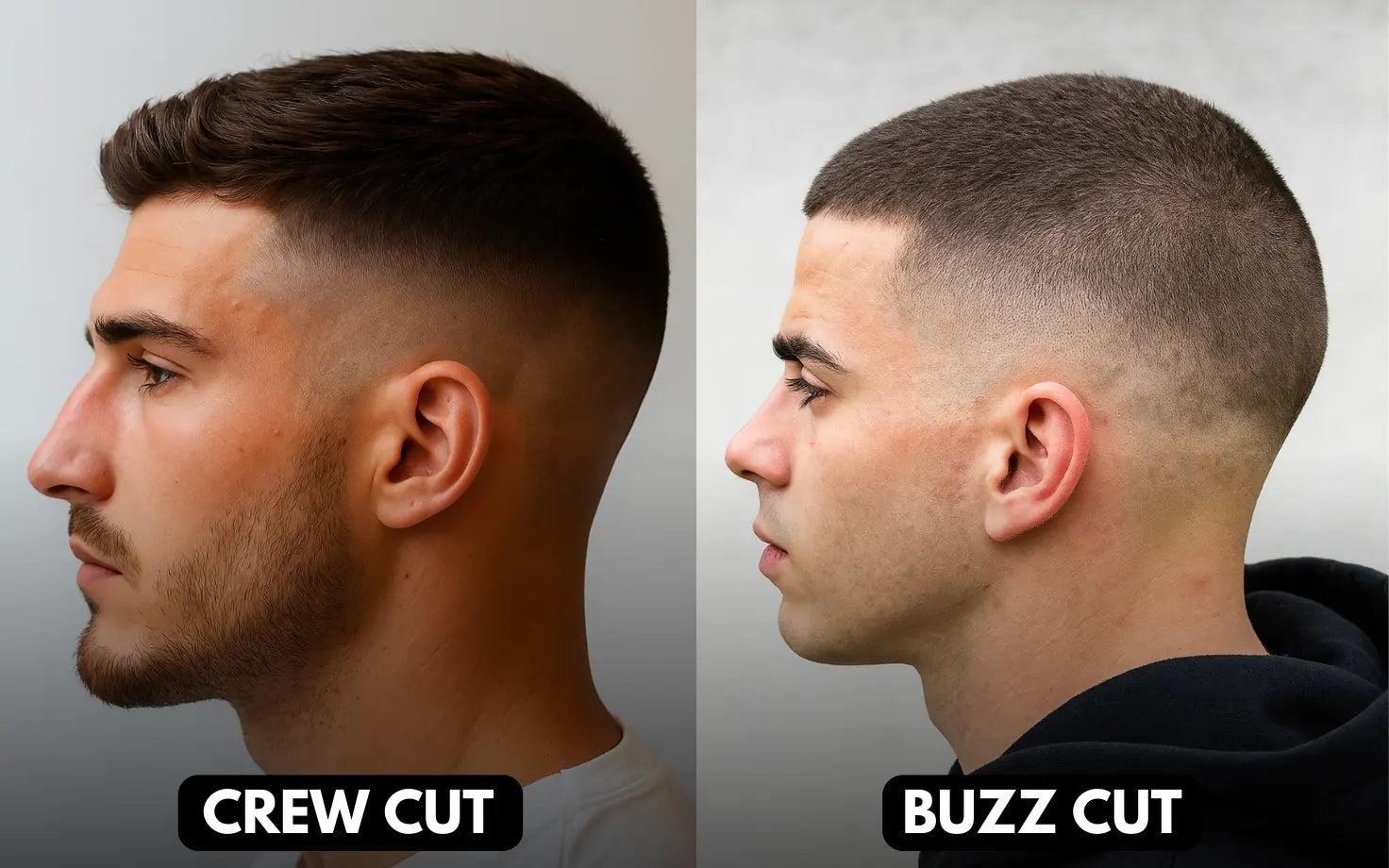
Crew cut and very short tops: usually nothing, or a fingertip of paste. At an inch or less there is little to direct. A tiny amount of paste can settle the surface and stop a short top looking fluffy after a wash; anything firmer is wasted.
Faux hawk and spiky short styles: fibre or firm clay. Upward, defined sections on thick hair need the strongest pliable hold on this list.
Longer short top (3–4 inches): firm matte cream or paste. Length gives thick hair some natural weight and fall. Heavy clay through a longer top can make it look stiff and separated in the wrong way; a cream or paste settles it while keeping movement.
Choosing by thick hair type
Thick and straight: the full menu works. Straight thick hair shows direction clearly and puffs symmetrically, so decide purely by finish — pomade for neat, clay for textured, paste for in between.
Thick and wavy: paste and pomade both enhance the wave without fighting it. Pomade gives a polished, deliberate wave; paste keeps it natural. Firm clay can rough a wave into looking frizzy if you rake it through too aggressively — apply it by pressing and pinching sections rather than dragging.
Thick and curly (short): go lighter and less drying than you expect. Short thick curls need definition and moisture retention, not oil absorption. A matte cream or a light paste, applied to damp hair and left alone once placed, defines curls without puff. Firm clays and fibres tend to separate short curls into frizz and leave them feeling dry; if you use clay on curls, keep it to a fingertip on the outline only.
Thick and coarse or wiry: firm pomade and firm paste are your reliable options, because coarse strands need smooth, sustained control. Clay works for texture but expect application drag — warm it longer and apply in thinner layers. Coarse hair also tolerates product quantity slightly better than fine thick hair, but build-up still arrives; wash it out properly rather than layering over yesterday’s product.
Thick hair that is also oily: clay earns its place, because its minerals absorb surface oil through the day. Avoid oil-based pomade entirely and keep water-based pomade amounts small.
How to apply product to thick short hair: step by step
- Start from the right hair state. Pomade goes on towel-dried, slightly damp hair. Clay, paste and fibre go on dry hair — or, for paste, barely damp at most. Applying a dry-hair product to wet thick hair dilutes it exactly where you need full strength.
- Blow-dry bulk down first, if you dry your hair. Direct the top in the direction of the final style and point the airflow downward to settle puff before product. This step alone fixes a large share of thick-hair styling frustration.
- Use two small layers, not one big one. Start with a pea-sized amount, emulsified fully between your palms. Work it back to front and root to tip, so the front does not receive the whole dose. Then assess, and add a second pea-sized layer only where control is missing — usually the crown, the fringe or a stubborn growth pattern.
- Get product to the roots. On thick hair, surface-only application styles the visible layer while the hair underneath pushes it back up within the hour. Rake with spread fingers so product reaches the base of the hair, where direction is actually decided.
- Shape, then leave it. Comb pomade styles into place and finish with fingers; finger-shape clay, paste and fibre styles and resist combing them smooth. Then stop. Repeated reworking of thick hair through the morning mostly redistributes product onto your hands.
- Check in profile. Thick hair’s failures — width at the sides, a shelf at the back of the top — are visible from the side, not the front. A two-second profile check catches what the front mirror view hides.
How to ask your barber to make thick hair easier to style
Product works twice as well on a cut that has already managed the bulk. When you sit down, these requests make a measurable difference for thick short hair:
- “Take the bulk out of the top, but keep the length.” Ask for point cutting or texturising through the top so the hair separates instead of sitting as a block. Say explicitly if you do not want thinning shears used heavily — over-thinned thick hair can spike and look wispy at the ends; many men with coarse hair prefer point cutting only. Agree which method before the cut starts.
- Guard lengths for the sides: a fade or taper that removes side bulk is the single biggest shape fix for thick hair. Common starting points are a #1 to #2 on a fade’s shortest point, blended up, or a #3 to #4 scissor-and-clipper taper for a softer classic shape — confirm the exact numbers with your barber against your head shape, and note the numbers that worked so you can repeat them word for word next visit.
- “Show me how much product you are using.” Barbers styling thick hair often use less product, better distributed, than clients use at home. Watching the amount and the order — back first, roots first — is free training; ask before they start styling, not after.
Upkeep cadence matters more with thick hair because growth shows as width quickly: most thick short cuts hold their shape for two to three weeks, and by week four the sides usually need a tidy even if the top could go longer. A quick sides-only tidy between full cuts is a normal, cheap way to keep thick hair looking intentional.
The mistakes that make thick hair look worse
Using a volumising product. Thickening sprays and mousses on already-thick short hair add puff and remove control. Check the label of anything marketed with “volume” or “thickness” — it was made for the opposite problem.
One large scoop instead of two small layers. A single large dose coats the front and the surface, leaves the back and roots bare, and still manages to look heavy. Layering is the thick-hair technique; quantity is not.
Styling the surface only. If the product never reaches the roots, the style is resting on top of hair that is pushing in its own direction. It will lose, usually before lunch.
Judging a product on freshly washed hair only. Thick hair styles differently on day two, when natural oils add grip and settle puff. A product that feels borderline on wash day may be perfect the next morning — and a firm clay that feels fine on wash day may feel dry by day three. Judge over a full wash cycle.
Layering new product over old build-up. Thick hair holds product at the roots, and adding a fresh dose over two days of residue gives you dull, unresponsive hair that no product seems to fix. If your hair suddenly stops styling the way it did last week, build-up is the first suspect, not a failed product.
Fighting the growth pattern at full strength. A strong cowlick or a swirling crown on thick hair will beat any product for part of the day. Styling with the direction of growth, or keeping that section slightly longer so its own weight helps, works better than escalating hold. Our cowlick and thick-hair cut guides cover the cut-side fixes.
Washing and build-up: the upkeep side
Thick short hair using firm products daily needs a proper wash rhythm. Water alone does not clear clay minerals, fibre waxes or pomade residue from dense hair at the roots. Shampoo thoroughly — working it to the scalp through the density takes longer than the quick pass that suffices for fine hair — and rinse longer than feels necessary, because residue hides in thick hair. Once a week, or whenever hair starts feeling coated and unresponsive, a second shampoo pass in the same wash resets build-up. You do not need a special routine beyond that: thorough, patient washing beats extra products. Conditioner is optional on very short tops and useful on longer short tops and coarse hair — apply it to the lengths and ends, not loaded onto the scalp, and rinse it out fully so it does not undo the control your styling product is about to provide.
What should you expect to pay?
Treat prices in bands, because they vary by retailer and region and change over time. Styling products for men sit in three broad bands: budget drugstore products at the low end, the wide mid-range of barber and grooming brands where most firm clays, pastes and water-based pomades live, and a premium band for boutique and salon labels. For thick short hair, the mid-range is the sensible default: firm hold and proper mineral or wax content are widely available there, a tin lasts a long time even at two pea-sized layers a day, and correct application makes a far bigger difference than moving up a band. Pay for the formula type you actually need — a true firm clay, a firm water-based pomade that washes out, a paste with real hold — rather than for fragrance or packaging. One caution specific to thick hair: very cheap firm products tend to achieve hold with heavy wax alone, which builds up faster in dense hair, so the budget band is a false economy more often here than it is for fine hair.
Frequently Asked Questions
What is the single best product for thick short hair?
For most men, a firm paste. It controls bulk, distributes through dense hair more easily than clay, stays reworkable through the day and finishes naturally without shine or dryness. Move to firm clay if you want a strongly textured, matte style, or to firm water-based pomade if you wear a neat, directed style such as a side part.
Is clay or pomade better for thick hair?
It depends on the style, not the hair alone. Clay is better for textured, separated, matte styles like crops and messy quiffs, and it helps thick hair that is also oily. Pomade is better for neat, combed, directed styles like side parts and classic tapers, and its slight weight helpfully settles bulk. Thick hair can use either successfully — unlike fine hair, it is not punished by pomade’s weight. Our pomade vs clay comparison linked above walks through the head-to-head in full.
How much product should I use on thick short hair?
Start with a pea-sized amount, applied thoroughly, then add a second pea-sized layer only where control is missing. Two small layers distributed properly outperform one dime-or-larger scoop every time on thick hair, because the problem is coverage of dense hair at the roots, not raw quantity on the surface.
Why does my thick hair puff out again an hour after styling?
Three usual causes: the product never reached the roots, so the hair underneath reasserted its direction; the product is too light for your hair’s density, which is common with soft creams and sprays; or the cut itself has regrown bulk at the sides and crown, which no product can fully correct. Fix them in that order — application first, hold level second, barber visit third.
Can product thin out thick hair or make it look less bulky?
Product can settle and separate thick hair so it looks less bulky, but it cannot reduce the amount of hair. Visible bulk reduction comes from the cut — texturising, point cutting and faded or tapered sides. Be cautious with any product or service promising to thin hair itself; the honest version of that claim is always about the cut or the finish, not the hair changing.
Should men with thick short hair use sea salt spray?
Not as a main product. Sea salt spray adds grit and apparent fullness, and thick hair needs neither as a headline effect. Its one useful role is as a light pre-styler on freshly washed hair, under a clay or paste, to add grip before the finishing product. Two or three sprays is enough; more adds bulk.
The short version
The best hair products for thick short hair are the ones built for control, not volume: firm clay for matte texture and separation, firm water-based pomade for neat, directed styles and settled bulk, firm paste as the forgiving everyday default, and fibre as a specialist for very short, defined styles. Apply any of them in two small layers, get them to the roots, blow-dry bulk down first if you dry your hair, and keep the cut’s bulk managed at the barber every two to three weeks. Thick hair is genuinely good hair to have — it holds styles other hair types cannot — and with the right product category and application, it stops being the hair that fights you and becomes the hair that does what it is told.