

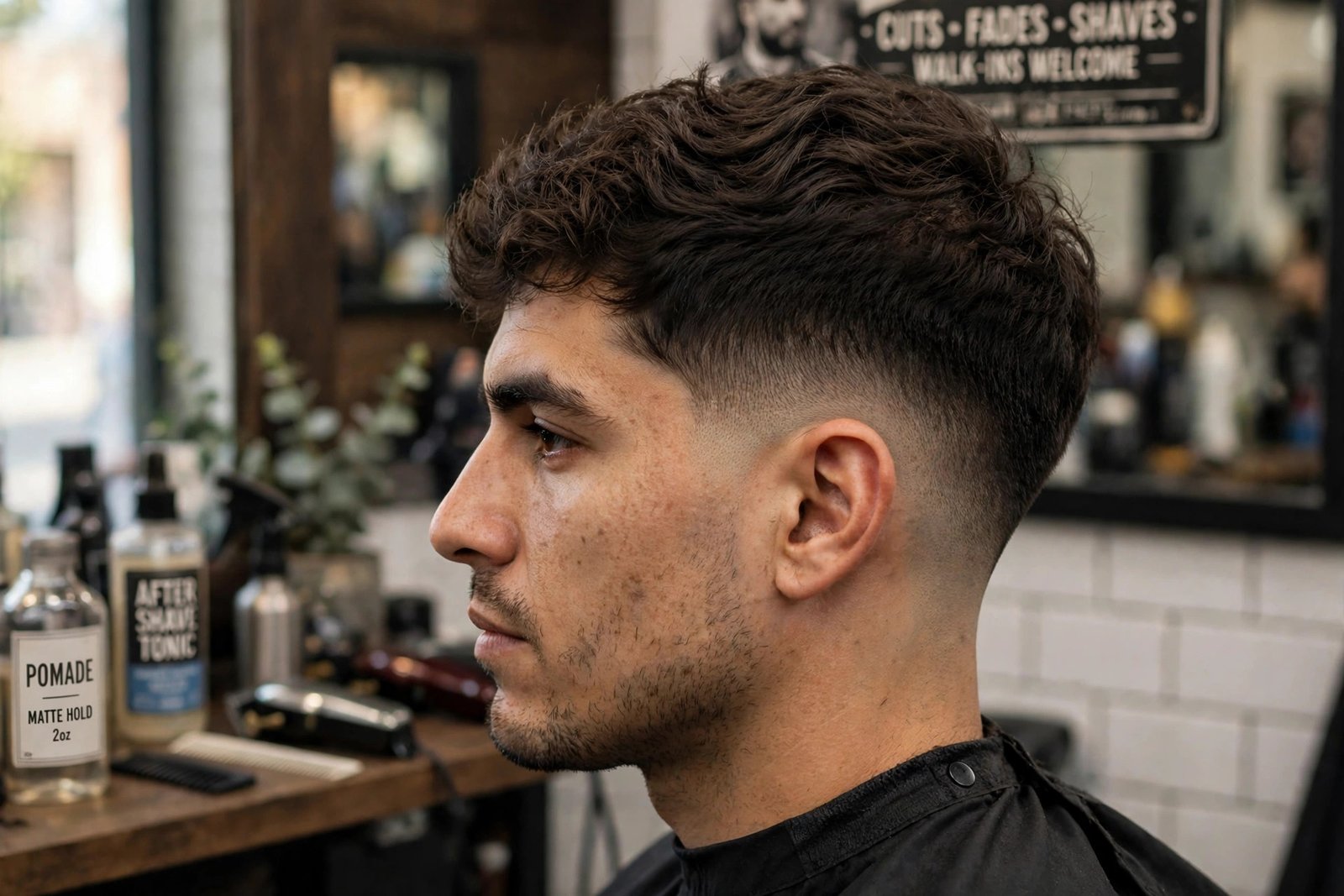
If you have short wavy hair for men with thick hair, you already know the paradox: it is the hair type barbers say everyone wants, and the hair type that misbehaves the fastest. The wave gives you natural texture and volume that straight hair has to fake with product. The thickness gives you density that thin hair can only envy. But together, thick wavy hair grows outward as much as it grows down, puffs up at the sides within two weeks of a cut, frizzes in humidity, and turns a good haircut into a rounded helmet if the barber leaves the wrong weight in the wrong place.
This guide is specifically about that combination — short, wavy, and thick — because general wavy-hair advice and general thick-hair advice each miss half the problem. Wavy guides assume your hair needs more volume; yours usually needs less bulk. Thick-hair guides assume your hair lies where it is put; yours springs back into an S-shape the moment it gets long enough to bend. Below you will find the cuts that genuinely work for this hair type, the exact words and guard lengths to use at the barber, what debulking actually means and when to refuse it, a daily routine that takes under five minutes, and the upkeep cadence that keeps thick wavy hair in the good zone instead of the puffy zone.
Why thick wavy hair behaves the way it does
Two separate properties are at work. Thickness here means density and strand size together: a lot of hairs on your head, and individual strands that are medium to coarse. Waviness means each strand follows a loose S-pattern instead of growing straight. When a wavy strand is very short, it cannot complete its bend, so it lies relatively flat. As it grows past roughly an inch and a half to two inches, the bend appears — and because you have so many strands, all bending at once, the hair gains visible width and lift away from the scalp.
That single fact explains almost everything about cutting this hair type well:
- The sides puff first. Hair at the temples and above the ears grows outward. If the sides are left at a medium length, they stick out and make the head look wider. This is why fades and tapers suit thick wavy hair so well — they remove the puff zone entirely.
- The top needs length, but not weight. You need enough length on top for the wave to show as texture rather than frizz, but the ends must be lightened so the wave sits down instead of stacking up.
- It grows out fast — visually. Thick wavy hair does not grow faster than anyone else’s, but every millimetre adds volume in three directions, so a cut can look overgrown at three weeks that would last five on fine straight hair.
If you want the broader menu for your wave pattern alone, our guide to the best short haircuts for wavy hair covers cuts across all densities. This article narrows that menu to the versions that survive thick hair.
The best short wavy hairstyles for men with thick hair
1. Textured crop with a mid fade
The strongest all-round choice for this hair type. The top is cut short — roughly one to two inches — and point-cut or lightly textured so the wave reads as forward movement instead of bulk. The fringe is worn forward and slightly broken up, which suits wavy hair because it works with the natural bend instead of fighting it. A mid fade on the back and sides removes the puff zone and keeps the silhouette tight.
Ask your barber for: a textured crop, scissors on top at about one to two inches with texture through the ends, fringe forward, and a mid skin or 0.5 fade blended into the top. Suits: most face shapes; especially good for square and oval faces and for men who want a low-effort morning routine. Upkeep: fade refresh every two to three weeks.
2. Short quiff with tapered sides
If you like height at the front, the quiff is the thick wavy man’s best version of it — your hair type holds a quiff with almost no effort because the wave and density provide the lift that fine hair needs a blow-dryer and strong product to achieve. Keep the top around two to three inches at the front, shorter towards the crown, and ask for the weight taken out of the mid-lengths so the front stands up instead of falling forward as a heavy wave.
Ask your barber for: a short quiff, two to three inches at the front graduating shorter to the crown, tapered or low-faded sides, and debulking through the top so it lifts. Suits: oval, round, and heart-shaped faces — the height adds length to rounder faces. Upkeep: trim every three weeks; this is the highest-maintenance cut on this list.
3. Crew cut with a taper
The crew cut is the safe, sharp option: short on top (a number 5 to number 8 guard, or scissor-cut to about an inch), slightly longer at the front, with tapered sides. On thick wavy hair the wave barely has room to form at this length, which is exactly the point — you get the density looking neat and full with almost no styling. Ask for the top to be cut following the head shape and the very front left a touch longer so it does not spike straight up as it grows.
Ask your barber for: a crew cut, around an inch on top left slightly longer at the front, with a taper (not a high fade) on the sides for a softer grow-out. Suits: everyone, and particularly men with strong jawlines, busy schedules, or a hairline they would rather not draw attention to. Upkeep: every three to four weeks; the taper grows out more gracefully than a fade.
4. French crop with a low fade and a disconnected fringe line
A close cousin of the textured crop, but with a straighter, blunter fringe line. On thick wavy hair the blunt line needs care: if the fringe is cut too heavy it sits like a shelf. Ask the barber to cut the fringe line in, then remove weight from behind it so the fringe lies flat and the wave softens the edge. The low fade keeps some weight low on the head, which balances a heavier top better than a high fade does on this hair type.
Ask your barber for: a French crop with a defined fringe, weight removed behind the fringe, and a low fade. Suits: oval and longer faces — the fringe visually shortens the face. Upkeep: two to three weeks.
5. Short side part with a taper fade
Thick wavy hair can do a classic side part, but only if the parting is chosen where the hair already wants to split — forcing a part against the wave’s natural fall is a daily losing battle. The top stays around two inches, combed to the side with the wave, and the barber cuts a subtle hard or soft part at the natural split. The taper fade keeps the sides controlled without the sharpness of a skin fade, which can look severe against a softer, classic top.
Ask your barber for: a side part on your natural parting, about two inches on top, weight removed from the bulky area above the ears, taper fade on the sides. Suits: professional settings, oval and square faces. Upkeep: three weeks, and it needs two minutes of combing each morning — the only cut here that does.
6. Buzz cut with a fade, for a reset
When thick wavy hair has been fighting you for months, a number 3 or 4 on top with a mid or high fade is a legitimate reset, not a surrender. At guard length the wave disappears, the density reads as an even, full shadow, and you learn your head shape and hairline honestly. It is also the benchmark cut: many men discover their hair was never the problem — the length was.
Ask your barber for: a number 3 or 4 all over the top, blended into a mid fade, with the hairline tidied but not carved into unnatural shapes. Suits: strong features, hot climates, gym-heavy routines. Upkeep: every two weeks to stay sharp, though it grows out evenly.
For comparison, our guide to the best short haircuts for thick hair covers the same density problem for straight and curly hair — the cuts overlap, but the lengths and debulking notes differ because the wave changes where the bulk sits.
How to ask your barber: the exact conversation
Barbers cut thick wavy hair well when you give them three pieces of information most men skip:
- Tell them where it puffs. Say “it grows outwards above my ears and gets wide at the sides by week two.” A good barber will respond by tightening the blend in that zone or suggesting a fade height that removes it.
- Ask for debulking by name, and ask which method. Debulking means removing weight without removing much length. The three methods: Point cutting — cutting into the ends at an angle; the safest method for wavy hair, it softens the ends and lets the wave sit down. Texturising / thinning shears — serrated scissors that remove a percentage of strands; useful high on the sides and through a heavy top, but overuse creates short hairs that stick out and cause frizz as they grow, so use sparingly and not near the front hairline or fringe ends. Slide cutting / razor work — can create soft movement, but on coarse wavy hair a razor can shred strand ends and increase frizz; most men with thick wavy hair do better with scissor texture.
- Agree the grow-out plan. Ask “what will this look like at three weeks, and what should I book next time — a full cut or a tidy-up?” Thick wavy hair often suits a pattern of a full cut, then a cheaper sides-only tidy at two weeks, then the full cut again.
Bringing a photo helps, with one warning: pick a photo of a man whose hair actually looks wavy and thick. A photo of the same cut on fine straight hair sets an expectation your hair type cannot meet, and a good barber will tell you so.
Guard lengths cheat sheet for thick wavy hair
- Number 1 (3 mm) and below: skin-close. Used in the lower part of fades. On thick hair, a skin fade grows back visibly within days because the density shows stubble fast.
- Number 2 (6 mm): the workhorse lower-side length; short enough to kill puff, long enough to avoid a harsh line.
- Number 3–4 (10–13 mm): buzz-cut territory on top, or the longest side length before puff returns for most men.
- Number 5–8 (16–25 mm): crew-cut top lengths. At a number 8 the wave just begins to bend — expect movement and the first hint of width.
- Scissor-cut top, one to three inches: where crops, quiffs, and side parts live. Above about three inches, thick wavy hair stops being a short haircut problem and becomes a medium-length styling problem.
The daily routine: five minutes, in order
Thick wavy hair does not need much product — it needs the right product in the right order, and usually less than you think.
Step 1 — Wash less, rinse more. Washing every day strips wavy hair and makes it frizzier and bigger. Most men with this hair type do best washing with shampoo two to three times a week, rinsing with water (or using a small amount of conditioner) on other days. Conditioner matters more for you than for almost any other hair type: it is what keeps coarse wavy strands lying together instead of separating into frizz.
Step 2 — Dry by pressing, not rubbing. Rubbing a towel over wavy hair roughs up the surface and creates frizz before you have styled anything. Press and squeeze the water out, or use an old cotton t-shirt, which is gentler. If you blow-dry, use medium heat and dry in the direction you want the hair to sit; for a quiff, dry the front upwards first, then set the direction.
Step 3 — Product on damp, not wet, hair. For most of the cuts above, a matte paste or a light clay in a pea-to-fingernail amount is enough. Warm it fully between your palms until it disappears, then work it through from the back and sides first, finishing at the front — this stops the front getting overloaded, which is the most common reason thick hair looks product-heavy. Our guide to the best pomade for men’s short hair explains when pomade is the right call instead — mainly the side part, where a little shine and comb-control help — and when it will make thick wavy hair look greasy.
Step 4 — Shape with fingers, finish with hands flat. Rake the hair into place with your fingers to keep the wave’s texture, then press the sides down with flat palms. The sides are where thick wavy hair betrays you by lunchtime; pressing them down while the product is fresh buys you hours.
Step 5 — Leave it alone. Every time you run your hands through thick wavy hair during the day you separate the strands and add volume. Touch it less and it stays where you put it.
For the full step-by-step system — including sea salt spray for enhancing the wave and second-day refreshes — see our routine guide on how to style wavy short hair, which was written for wavy hair of all densities and pairs with the cut advice here.
Mistakes that make thick wavy hair look worse
Growing the sides out “to blend.” It never blends; it widens. The sides of thick wavy hair should be the shortest, most controlled part of the cut almost every time.
Thinning shears everywhere. Over-thinned wavy hair frizzes, because hundreds of shorter strands escape the surface. If your hair looks worse two weeks after cuts that felt great on the day, over-thinning is the likely cause — ask for point cutting instead next time.
Using more product to fight volume. Volume in thick wavy hair is a cutting problem, not a product problem. Heavy product on un-debulked hair gives you greasy bulk instead of dry bulk. If you need more than a fingernail of product, you need weight taken out at the barber, not more from the tin.
Skipping conditioner. Coarse wavy strands without conditioner separate, frizz, and look thicker than they are. It is the cheapest debulking there is.
Waiting six weeks between cuts. At six weeks, thick wavy short hair is a different, wider haircut. Two-to-four-week cadence is not vanity for this hair type; it is the maintenance the hair type physically requires. Budget-wise, a sides tidy between full cuts keeps the shape for less than two full cuts a month.
Copying a straight-hair style exactly. A slick back or a sharp, wet-look finish fights your texture every hour of the day. The cuts that look best on thick wavy hair all let the wave show as dry, matte texture.
Which cut should you choose? A quick decision guide
- Lowest effort: crew cut with a taper, or the buzz-cut reset.
- Best all-rounder: textured crop with a mid fade.
- Most polished / office-safe: short side part with a taper fade.
- Most character / height: short quiff with tapered sides.
- Best for a receding hairline: textured or French crop — the forward fringe covers the corners honestly instead of exposing them.
- Best for a round face: the quiff, for height; avoid wide, low cuts that add width at the sides.
- Best for a long face: the French crop — the fringe shortens the face visually and the low fade keeps some width.
Frequently asked questions
What is the best short haircut for thick wavy hair?
For most men, the textured crop with a mid fade: it removes the puff at the sides, keeps enough length on top for the wave to read as texture, and needs almost no styling. The short quiff is the best choice if you want height at the front, and the crew cut with a taper is best if you want the lowest possible maintenance.
How often should men with thick wavy hair get a haircut?
Every two to four weeks, depending on the cut. Fades look sharpest with a refresh at two to three weeks because thick hair shows regrowth fast. Tapers and crew cuts can stretch to four weeks. A sides-only tidy-up between full cuts is a common and sensible pattern for this hair type.
Should thick wavy hair be thinned out?
Weight should be removed, but carefully. Point cutting is the safest method for wavy hair. Thinning shears are useful in small amounts through a heavy top and high sides, but overuse causes frizz as the shortened strands grow out and escape the surface. Ask your barber which method they plan to use, and ask them to go easy near the fringe and hairline.
What guard length is best for a buzz cut on thick wavy hair?
A number 3 or number 4 on top is the sweet spot: short enough that the wave cannot form and puff out, long enough that the density reads as even, full coverage. Go shorter only if you are comfortable with scalp showing at the temples and crown, where even thick hair is naturally less dense.
What product is best for short thick wavy hair?
A matte paste or light clay, used sparingly — a pea-to-fingernail amount worked through damp hair. Thick wavy hair needs control at the sides and definition at the front, not hold at all costs. Pomade suits the side part but can look greasy on crops and quiffs. If you find yourself using a lot of product, the real fix is debulking at the barber, not a stronger product.
Why does my thick wavy hair puff out at the sides?
Because wavy strands bend away from the head as soon as they are long enough to complete their curve, and thick hair has enough strands bending at once to create visible width. The fix is structural: shorter sides (a fade or tight taper), weight removed above the ears, and pressing the sides down with flat palms while styling. No product fully compensates for sides that are simply too long.
Does short hair suit thick wavy hair better than long hair?
For most men, yes. Short cuts keep the wave in its most manageable form — texture without volume problems — and the upkeep, while frequent, is quick. Longer thick wavy hair can look excellent, but it demands more product knowledge, more drying time, and tolerance for unpredictable days. Short is the version of this hair type that behaves.

