
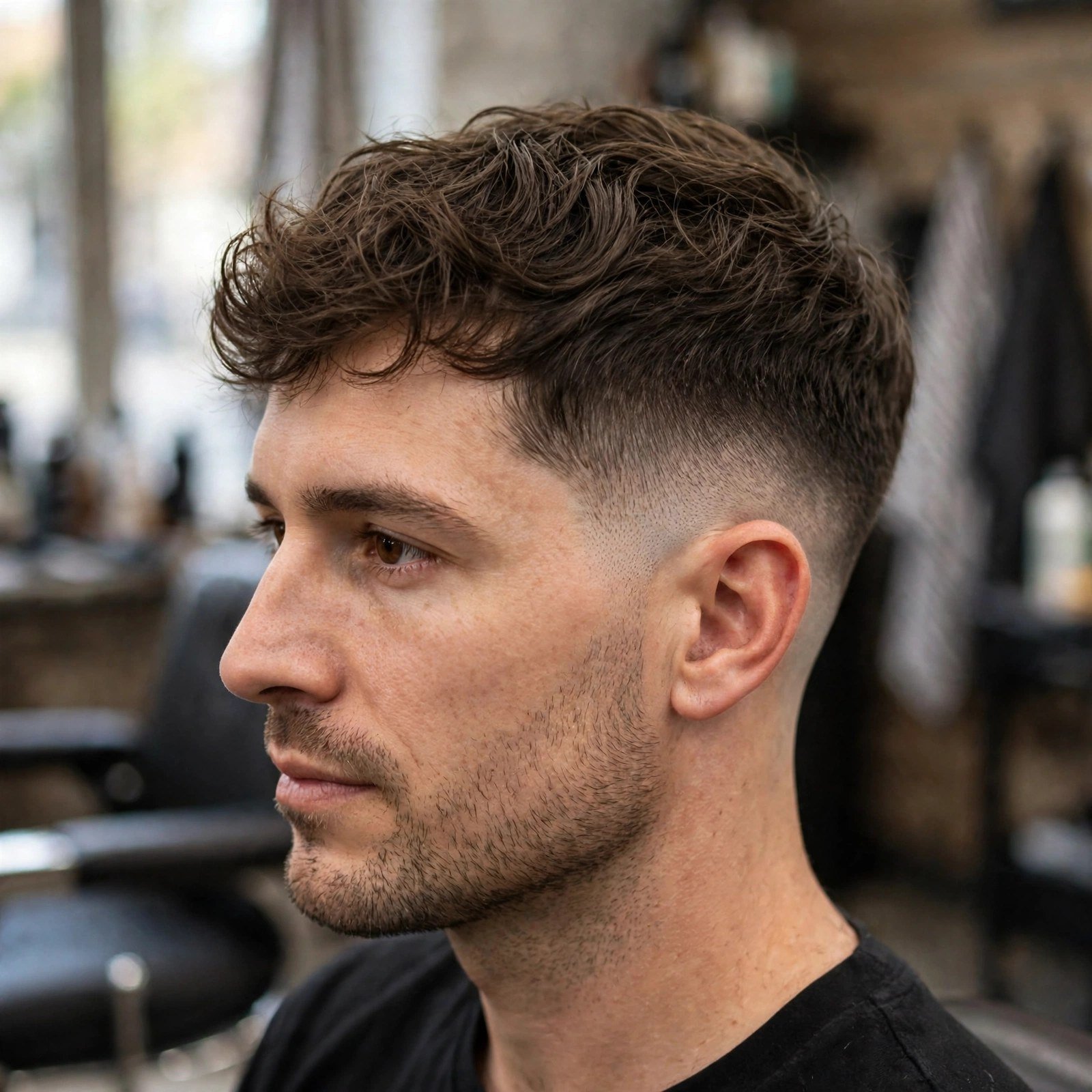
If you are looking for fade haircuts for wavy hair, you have probably already learned the hard way that a fade that looks perfect on straight hair can look completely different on yours. Wavy hair pushes out at the sides as it grows, it needs a certain length on top before the wave even shows, and it punishes a fade that is taken too high or blended too tightly. Get the fade right, though, and wavy hair is one of the best textures to pair with one: the fade removes exactly the part of wavy hair that causes trouble — the bulky sides — and leaves the wave where it belongs, on top.
This guide compares the fade haircuts for wavy hair that actually work in real life: the taper fade, the low fade, the low mid fade, the mid fade, and the skin fade, plus the drop fade as a variation worth knowing. For each one you will get who it suits, how much length it needs on top for the wave to read, the guard lengths involved, and how its grow-out behaves. There is also a full section on how to ask your barber for the fade you want, how to style the top without fighting your wave, and how often each fade needs refreshing. No single fade is best for every wavy head — the right choice depends on how strong your wave is, how thick your hair is, and how sharp you want the finish.
Why wavy hair changes the fade decision
A fade is not just a fade when the hair above it waves. Three things about wavy hair change what you should ask for compared with straight hair.
The wave needs length to exist. A wave is a bend, and a bend needs length to complete. Cut the top too short — roughly below an inch to an inch and a half for most men, depending on how loose or tight the wave is — and the hair does not wave at all; it just looks straight, fuzzy, or uneven. This is the most common mistake with fade haircuts for wavy hair: the fade is fine, but the top is taken so short that the texture the whole cut was meant to show disappears. If showing your wave is the point, the top length is a decision you make first, and the fade is chosen to support it.
Wavy sides expand as they grow. Straight hair on the sides tends to lie down as it grows out. Wavy hair grows outward. That means the sides of a wavy fade start to look puffy sooner than the same fade on straight hair, especially just above the ears and at the back corners. Fades that keep a little more shadow and length low on the head — low fades, low mid fades, and tapers — hide that expansion longer. Very high, very tight fades expose it fastest, because there is a harder line between the short fade and the expanding hair above it.
The blend has to meet a moving surface. On straight hair, the top of the fade meets hair that lies in one direction. On wavy hair, the hair at the transition is bending, so a blend that looks smooth on the day can show steps and shelves once the wave settles and dries naturally. A good barber blends wavy hair slightly softer and longer through the transition zone for exactly this reason. When you ask for your fade, asking for a soft, natural blend into the top — rather than a hard, high-contrast disconnect — is one of the most useful things you can say.
If you want the broader picture of cuts for this texture before you narrow in on fades, our guide to the best short haircuts for wavy hair covers the top styles cut by cut. This article picks up where that one leaves off: the fade itself.
The best fade haircuts for wavy hair, compared
1. Taper fade — the most natural option
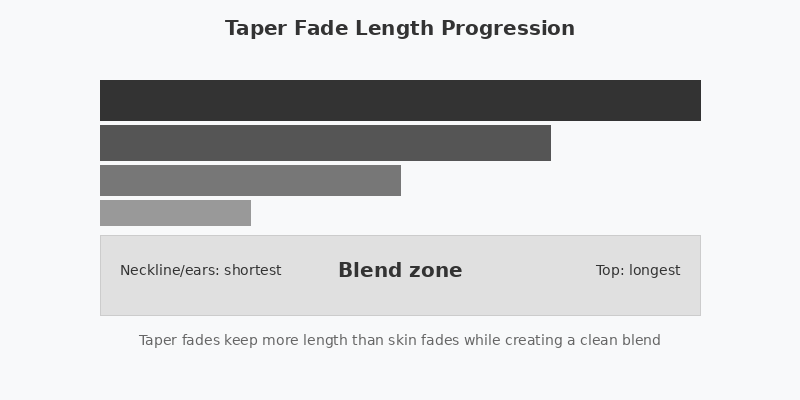
A taper fade only fades the sideburns and the neckline, leaving the rest of the sides at a scissor-cut or longer clipper length. For wavy hair, this is the most forgiving fade of all, because the sides keep enough length for the wave to lie in the same direction as the top, so there is no hard change in texture partway down the head.
Who it suits: Men with a loose to medium wave who wear the top at two inches or longer, men growing their hair out, and anyone who wants a barbered finish without a faded look. It is also the safest first fade if you have never had one, because almost nothing is taken high or short.
Top length for the wave: Two inches or more works best, worn as a side part, a brushed-back top, or a loose textured style.
Guard lengths: Typically a number 1 to 2 at the sideburn and neckline taper, blending into number 3 to 4 or scissor length above. Nothing needs to go to skin unless you ask for it.
Grow-out and upkeep: The best grow-out of any fade here — there is so little short work that it simply looks like a slightly longer haircut by week three or four. Refresh every three to four weeks, or even longer.
2. Low fade — clean sides, wave fully preserved
A low fade keeps the whole blend down near the ears and the neckline. The sides are cleaned up and tightened, but the fade never climbs high enough to compete with the top, so the wave keeps maximum room.
Who it suits: Most wavy hair, and especially medium to strong waves, thicker hair, and round or heart-shaped faces that benefit from keeping some width low on the head. It is the default recommendation if you are unsure — it is hard to regret a low fade.
Top length for the wave: One and a half to three inches. At the shorter end the wave reads as texture; at the longer end it reads as a clear wave pattern.
Guard lengths: Shortest point is usually skin, number 0, or number 0.5 low around the ears and nape, climbing through number 1 and 2, and meeting the top through a number 3 to 4 or scissor blend.
Grow-out and upkeep: Soft grow-out, because the fade starts low and there is less contrast to lose. The sides will start to puff at around two weeks if your hair is thick and wavy — that puff, not the fade line, is what sends most men back. Refresh every two to three weeks.
3. Low mid fade — the balanced modern choice
The low mid fade starts low around the ears and neckline, then rises to about mid height at the back and temples. It is sharper and more structured than a low fade, but it stops well short of the exposure of a full mid fade. For a lot of men with wavy hair, this is the sweet spot: the rise at the back removes the bulk where wavy hair expands most, while the lower start at the front keeps the cut from looking severe.
Our dedicated guide to the low mid fade haircut for men covers that height in full detail, including the exact points on your head to point to in the chair.
Who it suits: Wavy hair that puffs at the back and temples, men who found a low fade looked unfinished by week two, and oval, square, and round faces that want definition without a high fade.
Top length for the wave: One and a half to three inches, worn forward as a textured top or crop, or up as a short quiff. Keep the front long enough that the wave does not spring up and disconnect from the fade.
Guard lengths: Skin, 0, or 0.5 at the lowest point, through 1 and 2 in the blend, with a 3 to 4 or scissor transition. If your hair is fine as well as wavy, start the shortest point at 0.5 rather than skin so the sides keep a shadow.
Grow-out and upkeep: Cleaner for longer than a low fade — the sharpest window is about 10 to 14 days — and the grow-out stays softer than a mid fade. Refresh every two to three weeks.
4. Mid fade — sharper contrast, shorter top
A mid fade takes the blend up to around temple height all the way around. The contrast between the faded sides and the wavy top is the look — the wave sits on top of a clean, tight base and becomes the clear feature of the cut.
Who it suits: Men with a strong wave who wear the top shorter (a crop, a short fringe, or a tight textured top), men with oval or square faces, and anyone who re-books every two weeks without fail. It is less forgiving on very thick, fast-expanding wavy hair, because the higher line gives the puff nowhere to hide as it grows.
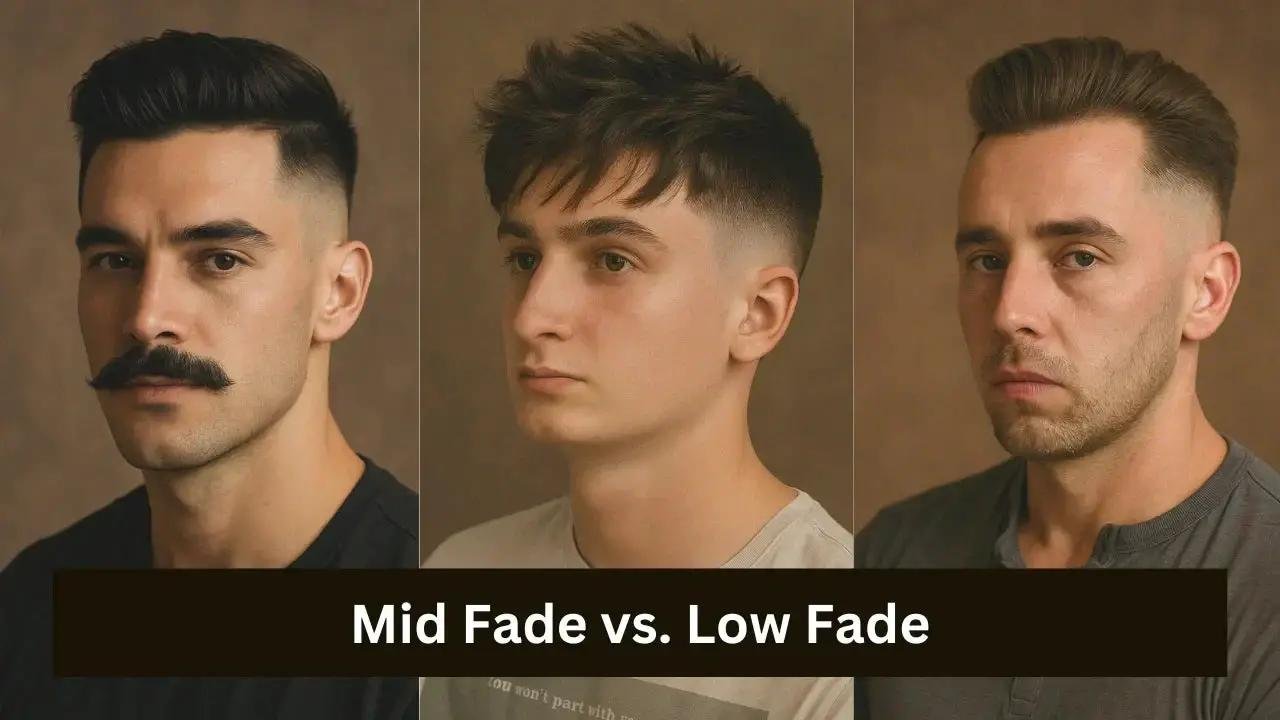
If you are weighing this against the low fade, our comparison of low fade vs mid fade walks through the difference in height, contrast, and upkeep side by side.
Top length for the wave: One to two inches is the natural pairing. Longer, heavier wavy tops can look top-heavy over a mid fade unless the barber removes weight through the transition.
Guard lengths: Usually skin or 0 at the base, through 1 and 2, meeting the top sooner than a low fade does — the blend is more compressed, which is why it looks sharper and also why wavy steps can show if it is rushed.
Grow-out and upkeep: The fastest to lose its edge of the fades so far. Plan on every two weeks, and expect the last few days before the appointment to look noticeably softer.
5. Skin fade — maximum sharpness, maximum upkeep
A skin fade is defined less by height than by its shortest point: the bottom of the fade goes all the way to skin. It can be low, mid, or high. On wavy hair, a low or low mid skin fade is usually the smart version — you get the crisp skin-clean finish at the edges while keeping the height decisions that suit your wave. A high skin fade with a wavy top is a bold, high-contrast look that works best with a short crop on top and a barber you see often.
Who it suits: Men who like the sharpest possible finish, shorter wavy crops and fringes, and anyone whose hairline and edges are a feature they like lined up.
Top length for the wave: One to two inches for mid and high versions; up to three inches can work over a low skin fade if the blend is kept soft at the top of the fade.
Guard lengths: Skin at the base, then 0.5, 1, and 2 through the blend. The jump from skin to wavy length is the whole skill of this cut — ask how your barber plans to soften the transition if your wave is strong.
Grow-out and upkeep: Skin grows out visibly within days. Every 10 to 14 days is realistic if you want it to stay looking like a skin fade; after that it is effectively a short low fade, which is not a failure — just know what you are booking.
6. Drop fade — a variation for the back and temples
A drop fade arcs down behind the ear, following the shape of the head, instead of running in a straight line around it. On wavy hair it pairs well with a top worn longer at the back, and it can flatter the back of the head where a straight fade line sometimes cuts across the wave awkwardly. Treat it as a shape variation you can apply to a low or low mid height, rather than a separate commitment: ask for a low mid drop fade, for example, if you like the idea.
Choosing by wave strength, thickness, and face shape
Loose wave (gentle bend, needs length to show): Protect the top length first. Taper, low, and low mid fades are your range. Avoid short crops over mid and high fades — the wave will not have room to form and the cut will read as straight and flat.
Medium wave (clear S-shape at one to two inches): The most flexible group. Low mid and mid fades both work, low fades are the safe option, and a low skin fade gives you sharpness without losing the wave.
Strong wave (bends quickly, close to curly): The sides are your problem area, not the top. Low and low mid fades that remove back and temple bulk without climbing too high serve you best. Ask the barber to blend into the wave rather than forcing a straight transition line, and keep the top at a length where the wave sits down instead of springing out.
Wavy and thick: Add weight removal to every conversation. The fade alone does not remove the bulk sitting just above the fade line — ask for the transition zone to be debulked and the top to be point-cut or lightly textured so it lies flatter.
Wavy and fine: Keep shadow on the sides. Start fades at 0.5 rather than skin, favour low heights, and keep the top textured and matte — shine and tight fades both make fine wavy hair look thinner than it is.
By face shape, briefly: Round faces do well with low mid and mid heights plus some lift on top. Long faces should stay with low heights and a forward-worn top, avoiding extra height. Square faces suit the softer low and low mid blends, which avoid making the head look boxy. Oval faces can choose on upkeep and wave strength alone.
Guard lengths for fade haircuts for wavy hair: a quick reference
- Taper fade: 1 to 2 at the taper points, 3 to 4 or scissors above, no skin required.
- Low fade: Skin, 0, or 0.5 at the base, 1 and 2 through the blend, 3 to 4 into the top.
- Low mid fade: Skin, 0, or 0.5 at the base, 1 and 2 through a longer blend, 3 to 4 or scissors into the top.
- Mid fade: Skin or 0 at the base, 1 and 2 in a tighter blend, meeting a shorter top.
- Skin fade (any height): Skin at the base, then 0.5, 1, and 2 — the 0.5 step is what keeps a skin fade on wavy hair from looking stepped.
On top, think in inches, not guards, once you pass about an inch: one to one and a half inches reads as texture, two inches shows a clear wave on most heads, and three inches gives a loose, flowing wave that needs the lower fades to balance it.
How to ask your barber for a fade with wavy hair
Barbers cut wavy hair well when the brief covers four things: the fade, the top, the blend, and the edges. Use this order:
1. Name the fade and its height in plain words. For example: “A low mid fade — low around the ears, rising to about mid at the back and temples.” Do not rely on the name alone; point to where you want the highest point of the fade to sit.
2. Say the shortest length. “Skin at the bottom” or “start at a zero point five” are both clear. If you have never had skin, start at 0.5 — you can go shorter next time.
3. Give the top length in inches and say the wave matters. “About two inches on top, and I want the wave to still show, so please do not take the top shorter to make the blend easier.” That one sentence prevents the most common wavy-fade disappointment.
4. Ask for a soft blend into the wave. “Blend into the top softly, following the wave, no hard line or disconnect.” Wavy hair rewards a softer transition and punishes a shelf.
5. Decide the edges. Natural or lined-up hairline, and a natural, tapered, or blocked neckline. A tapered neckline grows out most gracefully under every fade in this guide.
6. Bring two photos: one of the fade height from the side, one of the wavy top you want. A photo of straight hair styled the way you like will mislead the cut — find the same style on wavy hair if you can.
If it comes out wrong: Too low is an easy in-chair fix — the blend can be raised at the back and temples in minutes. Too high or too short on top cannot be put back, which is why starting lower and shorter-stepping is the right strategy for a first fade with a new barber.
Styling the wavy top above a fade
The fade needs nothing from you day to day. All your effort goes on the top, and the goal is to work with the wave’s direction instead of flattening it.
Dry in the direction you wear it. Wavy hair holds the shape it dries in. Towel-press rather than rub (rubbing creates frizz and breaks the wave apart), then blow-dry or air-dry pushing the hair the way you will wear it — forward for a crop or fringe, back and slightly up for a quiff, along the part for a side part. Our full routine guide on how to style wavy short hair covers the wash schedule and drying method step by step.
Use product for separation, not control. A pea-to-fingernail amount of matte paste or clay, worked through dry or nearly dry hair with fingertips, separates the wave into clean pieces. Heavy, wet-look product collapses a loose wave and makes a strong wave look greasy against clean faded sides. If you prefer pomade, choose a lighter, matte-leaning one and use less than the tin suggests — our guide to the best pomade for men’s short hair explains which finishes suit textured and wavy tops. Sea salt spray on damp hair is the other useful option for loose waves: it adds grit and encourages the bend without weight.
Apply back first, front last. Product the back and crown first, then the sides of the top, then use whatever is left on your hands for the front. This stops the fringe — the part everyone sees — from getting the heaviest dose and clumping.
Refresh the wave, not the whole head. On non-wash days, misting the top lightly with water and re-shaping it with your fingers resets most wavy tops in under a minute. Do not add a second full dose of product on top of yesterday’s — that build-up is what makes wavy hair look dull above a fresh fade.
For the full range of product types and how they compare on short hair, the best hair products for men’s short hairstyles hub is the overview to start from.
Upkeep: how often each fade needs the barber
- Taper fade: Every 3 to 4 weeks. The most forgiving schedule.
- Low fade: Every 2 to 3 weeks. Wavy side puff usually decides the timing.
- Low mid fade: Every 2 to 3 weeks, sharpest in the first 10 to 14 days.
- Mid fade: Every 2 weeks if you want it to stay sharp.
- Skin fade: Every 10 to 14 days. After that it has grown into a short fade.
Between visits, you can clean up the neckline and around the ears with care, but do not try to re-cut the blend itself — one uneven pass through a wavy transition is much harder for your barber to fix than two extra weeks of growth. If the top is getting heavy before the fade needs work, say so at the next visit and ask for more weight removal through the transition rather than a higher fade.
Common mistakes with fade haircuts for wavy hair
Taking the top too short for the wave. If the wave is the feature, guard the top length in the chair. An inch too little can erase the texture entirely.
Choosing the fade by photo alone. Most fade photos online show straight hair. The same height and guard numbers will look higher-contrast and grow out faster on wavy hair. Judge photos on wavy heads.
Going high to fix puff. When wavy sides puff at week two, the instinct is to ask for a higher fade next time. Usually the better fix is the same height with better weight removal above the fade line — a higher fade just moves the puff line up the head.
Over-producting to flatten the wave. More product makes wavy hair heavier, shinier, and more separated, not flatter. Drying direction and the right cut do the flattening; product only finishes it.
Booking a skin fade on a three-week schedule. There is nothing wrong with a skin fade that grows out — as long as you chose it knowing its sharpest form lasts about ten days. Mismatched expectations, not the cut, are what disappoint.
FAQ
What is the best fade for wavy hair?
For most men, a low fade or a low mid fade is the best starting point. Both remove the bulky sides where wavy hair causes trouble, keep enough shadow for a soft grow-out, and leave the top long enough for the wave to show. Move to a mid fade if you wear the top shorter and re-book every two weeks, and choose a taper fade if you want the most natural finish.
How long should the top be for wavy hair with a fade?
As a guide: one to one and a half inches shows texture, about two inches shows a clear wave on most heads, and three inches gives a looser, longer wave. If your wave is loose, stay at the longer end of those ranges; if it is strong, you can go a little shorter and still see it.
Does a skin fade work with wavy hair?
Yes, especially as a low or low mid skin fade. The skin-clean base contrasts well with a wavy top, but the blend into the wave needs to be soft, and the cut needs refreshing every 10 to 14 days to stay a true skin fade. A high skin fade works best with a short wavy crop on top.
Why does my fade look puffy after two weeks?
Because wavy sides grow outward, not down. The hair just above the fade line expands as it gains length, which reads as puff. It is normal for this texture, it is fastest with thick wavy hair, and the fixes are a two-to-three-week refresh cycle, weight removal through the transition zone, and drying the sides down and back rather than letting them air-dry outward.
Should wavy hair get a fade or a taper?
Choose a taper if you wear the top longer, want the most natural look, or want the longest time between visits. Choose a fade if you want the sides visibly clean and tight, the top to be the clear feature, and a more structured shape. Many men start with a taper, then move to a low fade once they know they like shorter sides.
What should I tell my barber if I have wavy hair?
Name the fade height and point to its highest point, state the shortest length (skin or 0.5), give the top length in inches and say you want the wave to still show, and ask for a soft blend that follows the wave with no hard disconnect. Finish by choosing a natural or lined-up hairline and a neckline style — tapered grows out best.
The bottom line
The best fade haircuts for wavy hair are the ones chosen around the wave, not in spite of it. Decide the top length your wave needs first, then pick the fade that supports it: a taper for the most natural finish, a low fade for the safest clean-up, a low mid fade for balanced structure and bulk control, a mid fade for sharper contrast with a shorter top, and a skin fade when you want the crispest edges and can keep a two-week schedule. Ask for a soft blend into the wave, keep the product light and matte, and let the refresh timing match the fade you chose. Do that, and the fade does what it is supposed to do for wavy hair — it takes away the trouble at the sides and leaves the texture on top as the best part of the cut.