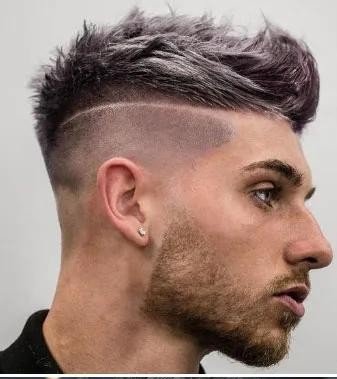

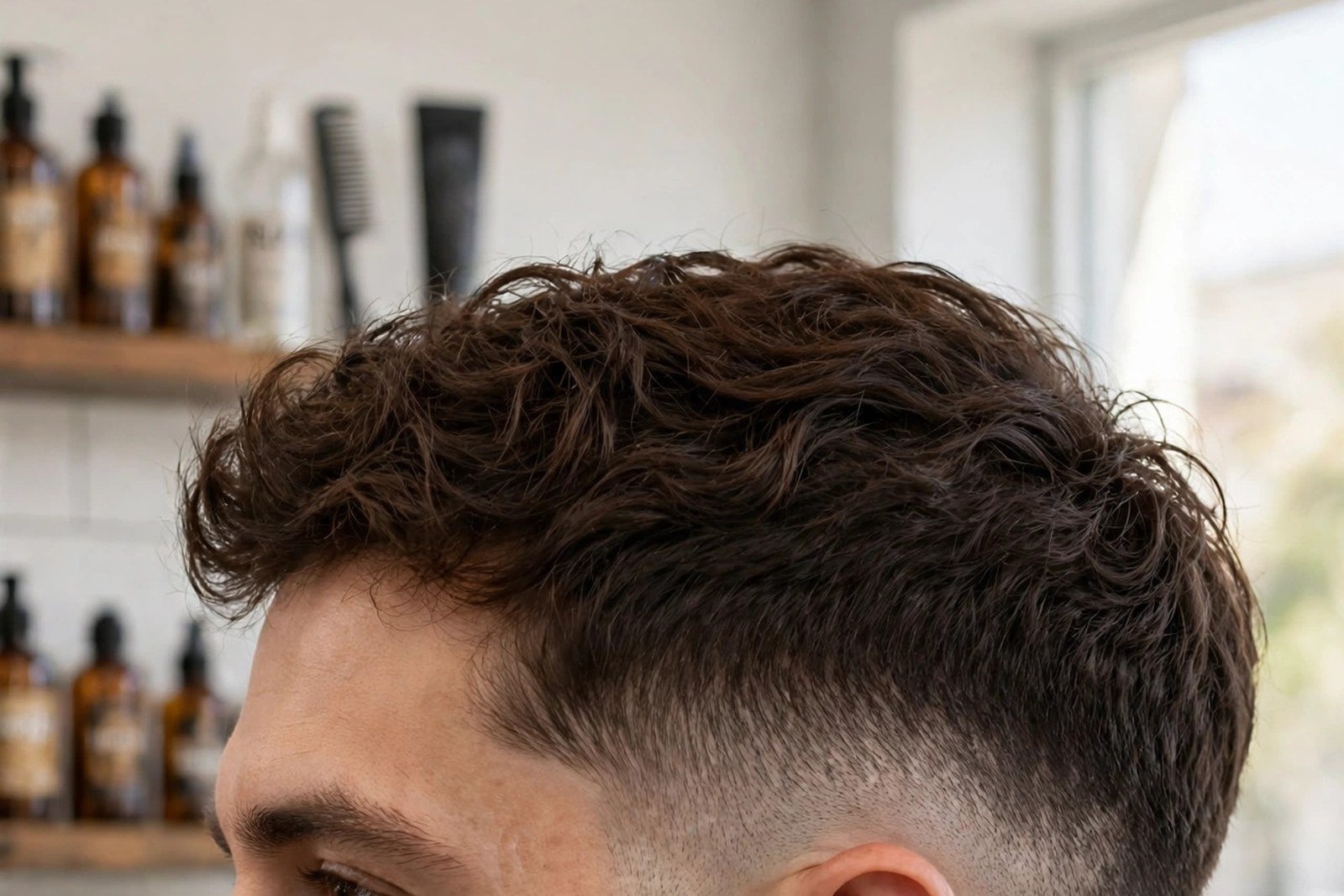
A crew cut for wavy hair is one of the smartest short cuts a wavy-haired man can ask for — if the lengths are chosen for the wave instead of against it. Cut at the right length, a crew cut keeps the natural movement and texture that makes wavy hair look good, while the short, tapered sides remove the puff and bulk that make wavy hair look unkempt as it grows. Cut too short on top, the wave has no room to form and the hair just looks fuzzy. Cut too long without debulking, the top swells into a rounded shape that no product fully controls. The difference between those two results is rarely the barber’s talent. It is the numbers you agree on before the clippers start.
This guide covers the crew cut for wavy hair properly: what a crew cut actually is, why wavy hair changes it, the exact top and side lengths that work for loose, medium, and tight waves, the main crew cut variations and who each one suits, how face shape changes the recommendation, the exact words to use with your barber, a daily styling routine that takes two minutes, the products that help and the ones that fight wavy texture, how often the cut needs refreshing, and the mistakes that ruin most wavy crew cuts. If you have been wearing your wavy hair either too long and messy or buzzed down out of frustration, this is the middle ground — short, clean, and still unmistakably wavy.
What a crew cut is — and how it differs from a buzz cut and a crop
A crew cut is a short cut where the top is cut short but keeps a clear graduation: longest at the front hairline, gradually shorter toward the crown, following the shape of the head. The sides and back are tapered or faded shorter than the top, so the silhouette stays neat and close at the edges while the top still has enough length to show texture and direction. In classic form the top is roughly a number 4 to a number 8 guard length at the front — about half an inch to an inch — though modern textured versions run longer.
That graduation is what separates a crew cut from its two closest neighbours. A buzz cut is one length all over, or nearly so: no front-to-back graduation, no real styling direction, and no texture to speak of once it drops below a number 4. Our buzz cut guide covers that cut in full if the all-one-length route appeals more. A textured crop, by contrast, keeps the top more uniform in length and pushes it forward onto a short, often blunt fringe; our guide to styling a textured crop at home shows that forward-swept finish. A crew cut sweeps up and back or stands with natural texture, keeps a natural hairline rather than a cut-in fringe, and reads more classic and athletic than either alternative.
For wavy hair specifically, the crew cut’s front-longer graduation is a genuine advantage. The front is where a wave shows best and where most men want the movement; keeping the most length exactly there, while the crown — where wavy hair likes to puff and stick up — sits shorter, works with the hair’s behaviour instead of fighting it.
Why wavy hair changes a crew cut
Wavy hair is not just straight hair with bends. Three behaviours change how a crew cut should be planned.
The wave needs a minimum length to exist. A wave is a curve, and a curve needs length to complete itself. Below roughly a number 4 on top (about 13 mm), most wavy hair cannot form a visible wave at all — it reads as straight-ish fuzz that sticks out at odd angles because the strands are too short to lie down and too short to bend. Between a number 5 and a number 8, the wave starts to show as gentle movement. Above an inch, full S-shaped waves form. This is why a crew cut that looks clean and wavy on one man looks wiry on another: the second man’s top was cut below his wave’s minimum length.
Wavy hair springs shorter when dry. Wavy strands sit longer when wet and stretched in the comb, then retract as they dry. A top cut to exactly one inch wet can sit noticeably shorter and puffier dry. Good barbers cut wavy tops slightly longer than the target and check them dry; if you are agreeing numbers, build in that margin rather than chasing a precise wet measurement.
Bulk gathers at the sides of the top, not the middle. Wavy hair tends to swell outward above the ears and at the parietal ridge — the widest part of the head — which rounds the silhouette and can make a crew cut look like a helmet within two weeks of growth. Managing a wavy crew cut is mostly about keeping that zone controlled: tapered sides that start high enough, and a top that is graduated so the widest point carries less weight. Our broader guide to the best short haircuts for wavy hair makes the same point across several cuts: with wavy hair, where the length comes off matters as much as how much comes off.
Crew cut for wavy hair: the lengths that actually work
Use these as the starting map, then adjust for how tight your wave is. Guard numbers refer to clipper guards on the top; many barbers will scissor-cut the top instead for a softer finish, in which case the same lengths apply in inches. Our explainer on men’s hair clipper guard sizes lists every guard in inches and millimetres if you want the conversions in front of you.
Loose waves (gentle bend, hair mostly lies flat)
- Top front: number 6 to number 8 (about 19–25 mm). Loose waves lie flatter, so you can wear the longer end of the crew range without puff.
- Top toward crown: graduate down to about a number 5. Keep the graduation gentle — loose waves show a harsh step more than tight waves do.
- Sides: taper or low fade from a number 2 down, or a number 3 tapered if you prefer a softer, classic edge.
- Watch-out: loose waves are the type most easily weighed down by heavy product. Keep styling light, covered below.
Medium waves (clear S-shape, some natural volume)
This is the most common wavy type, and the classic crew cut was almost designed for it.
- Top front: number 5 to number 6 (about 16–19 mm). This is the sweet spot: long enough for the S to form, short enough to stay tidy.
- Top toward crown: graduate to a number 4, keeping the crown a touch shorter so it does not kick up as it grows.
- Sides: a taper fade or low-to-mid fade from a number 1 to number 2 up into the top. Taking the sides shorter than the loose-wave version keeps the medium wave’s extra volume from rounding the silhouette.
- Watch-out: the parietal puff. Ask for the corners — where the top meets the sides — to be blended and lightly debulked, not left as a shelf of full-length hair.
Tight waves (deep waves bordering on curls, strong spring)
- Top front: number 4 to number 5 (about 13–16 mm). Tight waves form at shorter lengths, so you can wear the crew shorter and still see real texture. Going longer than a number 6 usually adds puff faster than it adds style.
- Top toward crown: graduate to a number 3 to number 4. Tight waves at the crown stand up readily; shorter there keeps the profile flat.
- Sides: a fade usually serves tight waves better than a classic taper, because the stronger contrast contains the volume on top. A low or mid fade both work; our comparison of fade heights for wavy texture, in the guide to the best fade haircuts for wavy hair, walks through which height suits which wave pattern.
- Watch-out: frizz at very short lengths. If your tight wave frizzes at a number 4, the fix is usually a fraction more length plus a light cream, not a shorter cut.
One rule applies to every wave type: keep at least two guard sizes of difference between the longest part of the top and the upper sides. Without that contrast, the graduation disappears and the cut reads as a buzz cut with good intentions.
The main crew cut variations for wavy hair
Classic crew cut with a taper. The traditional version: graduated top, sides tapered with clippers and scissors down to a natural, soft edge rather than a fade. This suits professional settings, softer facial features, and men who want the longest time between barber visits, because a taper grows out more gracefully than a fade. On wavy hair it looks best with loose to medium waves.
Textured crew cut. The top is point-cut or razor-detailed to break up the surface, worn pushed forward or up with a matte product rather than combed neatly. This is the most forgiving version for medium and tight waves, because the broken-up texture disguises the unevenness a wave naturally creates. Most younger wavy-haired men asking for a crew cut actually want this version — name the word “textured” so you get it.
Crew cut with a fade. The graduated top stays, but the sides are faded — low, mid, or down to skin. The fade sharpens the whole cut and contains wavy bulk better than a taper. A low mid fade is the balanced starting point for most men: clean contrast without the maintenance of a high skin fade. Choose this version if your sides puff out quickly or you want a more modern finish.
Longer crew cut (Ivy League). The top is left long enough to comb to the side with a small part — roughly one to one and a half inches at the front — with short tapered sides. It is still a crew cut family member, just the longest one. For loose waves this can look excellent, the wave giving the side-swept top natural movement. For tight waves it usually needs more daily styling than the shorter versions, which defeats the crew cut’s low-effort appeal.
Short crew cut (butch-leaning). Top at a number 3 to number 4 with a tight fade. Be honest about the trade: at this length most waves disappear, and what remains reads as texture and direction rather than wave. It suits men whose waves only behave badly — cowlicks, uneven patterns — and who would rather remove the wave from the equation than manage it. Our guide to short cuts for men with cowlicks covers that problem pattern in more depth.
Which face shapes suit a wavy crew cut
A crew cut adds a little height and structure on top while keeping the sides close, which makes it adaptable — but the variation and lengths should shift with your face.
- Round faces: choose the faded version and keep the top at the longer end of your wave’s range, styled up rather than forward. Height on top and tight sides lengthen the face’s appearance; a soft taper and a forward, flat top do the opposite.
- Square faces: almost every version works. A classic taper softens a strong jaw slightly less aggressively than a skin fade; if you want to keep the sharp, masculine read, the faded version preserves it.
- Oval faces: the balanced case — pick the variation by wave type and lifestyle rather than face shape.
- Long or rectangular faces: keep the top shorter and the sides less severe. A mid or high skin fade plus a long top exaggerates length; a number 5 top with a taper or low fade keeps proportions in check.
- Heart-shaped faces (wider forehead, narrower chin): avoid the tightest fades, which widen the top of the silhouette further. A tapered side keeps width where you want it — lower.
Our complete guide to choosing short haircuts by face shape goes deeper on each shape if you want to cross-check before committing.
How to ask your barber for a crew cut for wavy hair
Wavy hair punishes vague instructions, because two barbers can hear “short on the sides, a bit longer on top” and produce cuts an inch apart. Use numbers, name the graduation, and name the wave. This script covers it:
“I’d like a crew cut. On top, a number [5/6 — use your wave’s number from above] at the front, graduating shorter toward the crown, about a number [4] at the back of the top. Keep the texture natural — point-cut it if you can, I don’t want it blunt. On the sides, [a taper / a low mid fade] starting at a number [1/2], blended into the top with no shelf at the corners — my hair puffs out above the ears, so please take the weight out there. Natural hairline, don’t edge it up. And can you check the top dry before finishing? My wave springs up when it dries.”
Four details in that script do real work. First, the front-to-crown graduation is stated, so you get a crew cut rather than a uniform crop. Second, “point-cut, not blunt” protects the wave’s texture. Third, naming the puff zone above the ears tells the barber where your hair misbehaves — local knowledge no guard number carries. Fourth, the dry check prevents the classic wavy mistake of a top that looked right wet and sits too short an hour later.
Bring a photo if you can — ideally of a man whose wave looks like yours, not a straight-haired model whose crew cut your hair physically cannot copy. And if your barber suggests a half-size longer on top than you asked for, hear them out: on wavy hair, the barber can see the spring and dry behaviour that a mirror at home hides.
How to style a wavy crew cut: the two-minute routine
A crew cut should not need a long routine, and for wavy hair the goal is specific: encourage the wave on top, keep it from frizzing or puffing, and leave the faded or tapered sides completely alone. This routine, matched to the fuller system in our guide on how to style wavy short hair, takes about two minutes.
- Start on damp hair, not dripping and not bone dry. After a shower, towel-dry until the hair is damp. Wavy hair sets its pattern as it dries; product applied to damp hair distributes through the wave, while product on dry wavy hair tends to sit on the surface and look piecey.
- Use less product than you think. A pea-to-fingertip amount for the whole top is the right scale at crew lengths. Warm it fully between your palms first — visible product on your hands means visible clumps in short hair.
- Work it back to front, then finish front to back. Applying against the growth first coats the roots and the underside of the wave; the final pass in your styling direction — up and slightly back for a classic crew, forward for a textured one — sets the surface. Skipping the first pass is why short wavy hair often looks styled on top and dry underneath.
- Shape with fingers, not a fine comb. Fingers preserve the wave’s clumps; a fine comb pulls the wave apart into frizz and then the hair springs back unevenly anyway. A wide-tooth comb is acceptable for the longer Ivy League version only.
- Let it air-dry if you can; diffuse if you cannot. Heat from a dryer on full blast blows wavy texture apart. If mornings require a dryer, use low heat and low airflow, or a diffuser attachment, and stop while the hair is still very slightly damp — it will settle the last fraction on its own and hold its pattern better.
- Do not touch it once dry. Every re-arrangement of dry wavy hair separates the wave clumps a little more. By mid-afternoon, hands-off hair still looks like a crew cut; fussed-with hair looks like a crew cut plus frizz.
On non-wash days, the refresh is water, not more product: wet your hands, run them through the top to reactivate yesterday’s product and reset the wave, reshape with fingers, and leave it. Adding fresh product daily on top of old product is the fastest route to the dull, heavy build-up that makes short wavy hair look dirty.
Products that help wavy crew cuts — and what to avoid
Short wavy hair needs light control and a little moisture, not maximum hold. In the price bands below — budget (drugstore range), mid-range (barbershop and premium drugstore range), and premium (salon range) — the category matters far more than the brand, and owner feedback across all three bands makes the same points.
Matte paste — the default choice. A light-to-medium hold matte paste gives the top definition without gluing the wave straight or adding shine that makes short hair look greasy. Most wavy crew cuts are best served here. Our hub guide to the best hair products for men’s short hairstyles compares paste against every other category if you want the full picture.
Light cream or leave-in conditioner — for dry or tight waves. If your wave frizzes more than it misbehaves, a small amount of styling cream adds the moisture and soft control paste cannot. Tight waves and coarse wavy hair benefit most. Creams sit mostly in the budget and mid-range bands and are the category owners with dry hair most often say they waited too long to try.
Pomade — only the right kind, only for some crews. A light, water-based pomade can suit a classic or Ivy League crew combed to the side, adding the neat finish that version wants. But heavy or oil-based pomade weighs a wave flat and is hard to wash out of short hair. Our guide to the best pomade for men’s short hair explains which finishes work on short lengths — if you use pomade on a wavy crew, it should be the light end of that guide, on loose waves only.
Sea salt spray — a pre-styler for loose waves. A light mist on damp hair before paste can emphasise a loose wave that otherwise falls flat by midday. It is an enhancer, not a holder; on its own it will not control medium or tight waves.
What to avoid: hard-hold gels, which dry crunchy, flake visibly on short hair, and straighten the wave you are trying to keep; heavy waxes and clays in large amounts, which suit very short, straight textures but sit on wavy hair like grease; and oils applied to the roots, which collapse volume at crew lengths. The pattern is consistent — wavy crew cuts fail from too much weight and too much hold far more often than from too little.
How often a wavy crew cut needs a trim
The top of a crew cut is forgiving — an extra quarter inch of growth still reads as a crew cut. The sides decide when the cut looks overgrown, and the fade or taper decides how urgent that looks.
- Crew cut with a skin or tight fade: the fade starts losing its sharpness at about two weeks, and most men who care about the contrast re-cut every two to three weeks.
- Crew cut with a low mid fade or taper fade: every three weeks is the comfortable rhythm; the softer blend tolerates a third week well.
- Classic tapered crew cut: every three to four weeks, the longest interval of the group, because the soft edge grows out as a slightly longer version of itself rather than as a visible line.
- Wavy-specific note: as wavy hair grows, the wave gets stronger and heavier, so the top’s behaviour changes between week one and week four more than straight hair’s does. If your crew looks perfect in week two and puffy in week four at the same styling routine, that is growth changing the wave, not your routine failing — the trim interval, not more product, is the fix.
Between visits, a neckline and around-the-ear tidy extends any version by about a week. Keep notes on the numbers you settled on — front guard, crown guard, side type — so each visit starts from your proven version rather than a fresh negotiation.
Common mistakes with wavy crew cuts
Cutting the top too short for the wave. The single most common failure. If you want visible wave, the front of the top must stay at or above your wave’s minimum length — a number 5 for most medium waves. A number 3 crew on wavy hair is a fine cut, but it is a textured buzz, not a wavy crew, and expecting wave from it disappoints every time.
Asking for a photo of straight hair. A crew cut on straight hair sits flatter, sharper, and more uniform than the same numbers produce on wavy hair. Choose reference photos by matching hair type first and style second.
Leaving the corners heavy. If the transition where the top meets the sides keeps full weight, wavy hair builds a shelf there within days and the silhouette rounds out. The corners need blending and light debulking at the cut, not product afterwards.
Fighting frizz with more hold. Frizz on a wavy crew is usually dryness or over-handling, not insufficient hold. Stronger product makes it heavier and often frizzier by afternoon. A cream, less touching, and a fraction more length solve more frizz than any maximum-hold product.
Washing the wave away daily with harsh shampoo. Daily washing with a strong cleanser dries wavy hair out, and dry wavy hair puffs. Most wavy crew cuts do best washing every two to three days and rinsing with water in between — our shampoo guide for men’s short hair covers choosing a cleanser by hair type in detail.
Judging the cut wet in the barber’s chair. Wavy hair sits longer and flatter wet. A crew that looks perfect wet can sit an effective guard size shorter dry. Ask for the dry check, and judge your own cut at home only once it is fully dry.
Frequently asked questions
What length is a crew cut for wavy hair?
For most men with medium waves, a number 5 to number 6 on top at the front (about 16–19 mm), graduating to about a number 4 toward the crown, with sides tapered or faded from a number 1 to number 2. Loose waves can go a size longer on top; tight waves a size shorter, because their wave forms at shorter lengths.
Is a crew cut good for wavy hair?
Yes — it is one of the best short options, because its front-longer graduation keeps the most length exactly where a wave shows best, while short tapered or faded sides remove the bulk and puff that make wavy hair look untidy. The key condition is keeping the top long enough for your wave to form, usually a number 5 or above at the front for medium waves.
Should wavy hair get a taper or a fade with a crew cut?
Both work, and the choice is about maintenance and how much your sides puff. A taper is softer, more classic, and grows out gracefully over three to four weeks, suiting loose waves well. A fade — a low mid fade is the balanced starting point — gives cleaner contrast, contains medium and tight waves’ bulk better, and needs refreshing every two to three weeks.
How do you stop a wavy crew cut from puffing out?
Three things, in order: get the corners between the top and sides blended and debulked at the cut itself; keep the sides short enough that growth there cannot add width — a fade controls this longer than a long taper; and style with a small amount of matte paste on damp hair rather than heavy product on dry hair. Puff that appears only in week four is growth, and the answer is the trim, not more product.
What product is best for a crew cut with wavy hair?
A light-to-medium hold matte paste is the best default for most wavy crew cuts: it defines the wave without weight or shine. Dry or tight waves often do better with a light styling cream or a cream under a little paste. Avoid hard gels and heavy waxes, which flatten or grease the wave, and keep the amount small — pea-to-fingertip sized for the whole top.
How often does a wavy crew cut need cutting?
Every two to three weeks with a fade, every three to four weeks with a classic taper. Wavy hair changes character as it grows — the wave strengthens and the top gets heavier — so wavy crew cuts usually sit at the shorter end of those intervals compared with the same cut on straight hair.
Can you get a crew cut if your wavy hair is also thick?
Yes, and it is a common, good combination — thick wavy hair is exactly the type whose bulk a crew cut’s short sides and graduated top are built to remove. Ask the barber to debulk the top’s corners and consider point-cutting or light thinning only in the heaviest zones. Avoid heavy thinning-shear work all over the top, which on wavy hair often creates frizz at the ends of the thinned strands as they grow out.
The bottom line
A crew cut for wavy hair works when the cut respects the wave’s minimum length, graduates from a longer front to a shorter crown, and takes the bulk out of the sides and corners where wavy hair actually gathers it. Start with a number 5 or 6 at the front for medium waves, choose a taper for the softest grow-out or a low mid fade for the cleanest contrast, give your barber numbers rather than adjectives, and style with a fingertip of matte paste on damp hair, shaped with your fingers and then left alone. Do that, and you get the crew cut’s whole promise — two minutes in the morning, clean edges, and a top that still looks like your hair — instead of a short cut that fights your texture for three weeks until the next one.