
A high fade haircut is the boldest of the common fade heights — and the easiest to get wrong by asking for it vaguely. Done well, a high fade gives short hair a clean, sharp silhouette: the fade starts high on the sides, close to where the top begins, so most of the side of the head is very short and the length lives only on top. Done without a plan, it can expose scalp, exaggerate a long face, show every bump and cowlick on the sides, and grow out faster than you expected. The difference is not luck. It is where the fade starts, how short it goes at the bottom, what length you keep on top, and whether that combination suits your head and hair type in the first place.
This guide covers the high fade haircut properly: what “high” actually means in barber terms, how it differs from a low fade and a mid fade, the guard lengths that work on the sides and on top, the difference between a high skin fade and a high taper fade, which face shapes and hair types it suits and which it fights, the exact words to use with your barber, how to style the top, how often it needs re-cutting, and the mistakes that make most high fades look off within a week. If you have been looking at high fade photos and wondering whether the cut will look like that on you, this is the honest version — including when the answer should be a low mid fade instead.
What a high fade haircut actually is
A fade is a gradual blend from very short hair at the bottom of the sides and back to longer hair higher up, with no visible line where one length stops and the next starts. The word before “fade” — low, mid, or high — describes where that blend starts on the head, not how short the bottom is. Those are two separate choices, and confusing them is the most common source of disappointing fades.
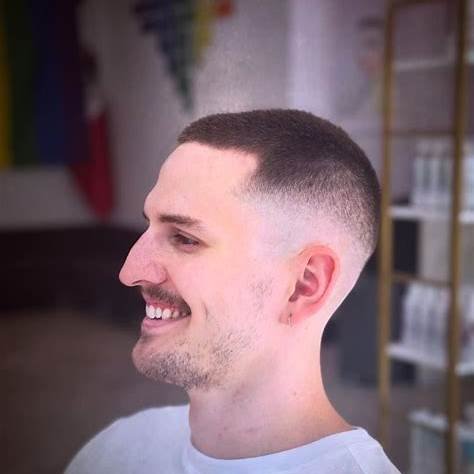
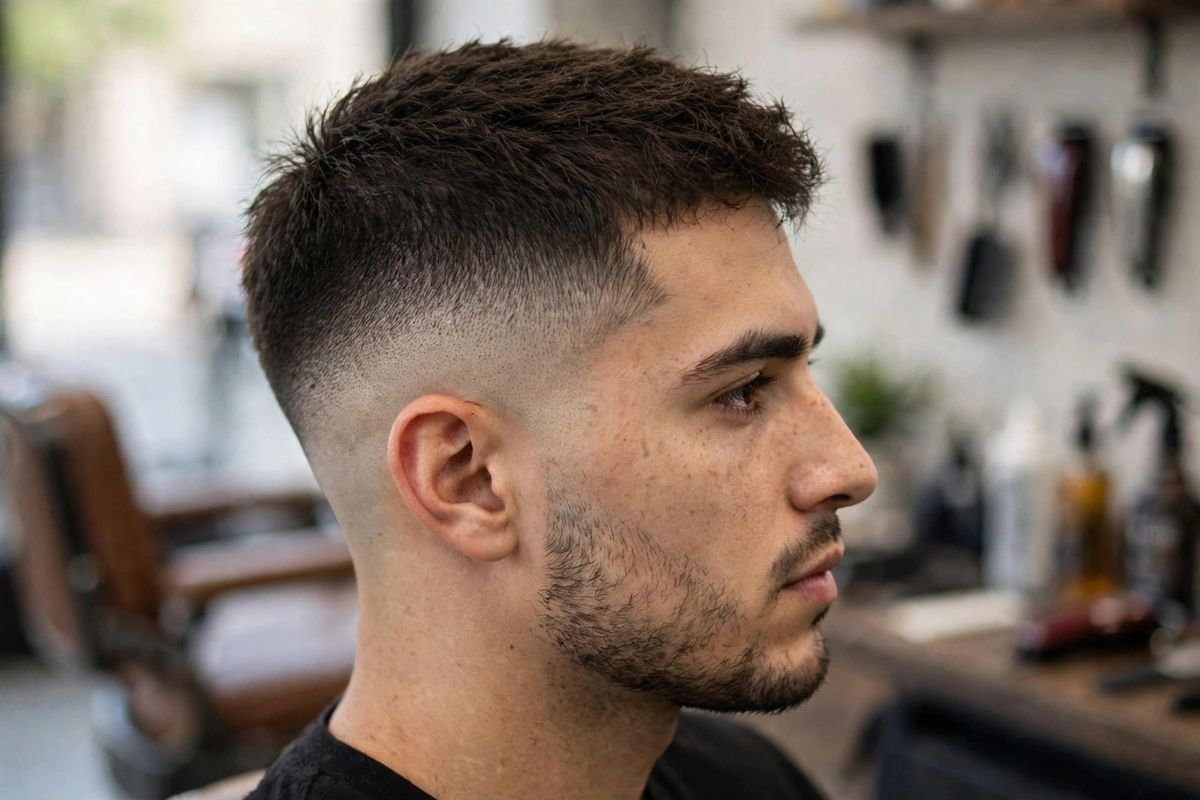
A high fade starts its blend high: roughly at or just below the temple line, around the upper third of the side of the head, near where the side meets the top at the parietal ridge. From that high starting point, the hair transitions quickly down to the shortest length at the bottom. The visual result is a lot of very short side, a relatively small zone of blending, and a strong contrast between the sides and whatever length you keep on top.
Compare that with the alternatives already covered on this site. A low fade starts just above the ear and around the lower back of the head, keeping more length on the sides and giving the softest, most classic result. A mid fade starts in between. Our comparison of low fade vs mid fade walks through those two heights in detail, and our low mid fade haircut guide covers the in-between height that has become the balanced starting point for a lot of men. A high fade sits above all of them: it is the highest, tightest, and highest-contrast member of the family.
The second choice — how short the bottom goes — is independent. A high fade can end in a number 1, a number 0.5, or skin (often called a high skin fade or high bald fade). “High” tells your barber where to start; the bottom number tells them where to finish. You need to name both.
High fade vs low fade vs mid fade: choosing the height
Height changes three things at once: how sharp the cut looks, how much scalp and head shape shows, and how fast it grows out.
Low fade. Starts low, keeps the most side length, blends over a tall zone. Softest contrast, most forgiving of head shape, bumps, and uneven growth, and the slowest to look overgrown. Best for professional settings, first-time fades, and men who want three or more weeks between cuts.
Mid fade. Starts around the temple height’s lower edge, in the middle of the side. Balanced contrast — clearly a fade, without committing to the full high-fade look. A good middle ground if you like the high fade photos but are not sure about exposing that much side.
Low mid fade. Starts between low and mid. As covered in the low mid fade guide, this is often the sweet spot for wavy and thick hair, because it gives clean contrast while leaving enough side length to control puff.
High fade. Starts highest, blends over the shortest zone, shows the most very-short side. Sharpest contrast, most modern and athletic read, least forgiving, and fastest to lose its edge as it grows. Choose it deliberately, not as a default.
A useful test: if you like a photo, look at where the longest side hair sits. If there is almost no mid-length hair on the side at all — the head goes from skin or near-skin to top length within a short distance — that is a high fade, whatever the caption calls it. If there is a clear band of short-but-visible hair on the upper side, you are probably looking at a mid fade.
High fade haircut guard lengths: sides and top
Guard numbers are the shared language here. Our explainer on men’s hair clipper guard sizes lists every guard in inches and millimetres if you want the full table in front of you. For a high fade, plan the cut in three zones.
The bottom of the fade
- Skin (no guard, foil or razor finish): the sharpest high skin fade. Maximum contrast, maximum scalp visibility, and the fastest to show growth — stubble is visible within days. Best on even scalps without prominent moles, scars, or bumps you would rather not highlight.
- Number 0 to 0.5 (about 0–3 mm with the lever): near-skin without the full bald finish. Almost the same sharpness, slightly more forgiving, and a common professional compromise.
- Number 1 (about 3 mm): the softest high fade bottom. Still clearly high and tight, but reads as very short hair rather than skin. A good first high fade if you are stepping up from a mid fade.
The blend zone
Because a high fade blends over a short vertical distance, the blend has to be more precise than on a low fade — there is less room to hide a step. Barbers typically work through the half sizes between your bottom number and the top’s side length, opening and closing the clipper lever to erase lines. You do not need to specify every intermediate number; you do need to give the barber time and not ask for a high skin fade as a five-minute job.
The top
The top length decides what the high fade is framing. Common, proven pairings:
- Textured crop on top: about a number 5 to number 8 equivalent in scissor length (roughly 16–25 mm), point-cut and worn forward or natural. The contrast between a tight high fade and a textured, matte top is the most popular modern high fade combination.
- Crew cut on top: graduated front to crown, roughly a number 4 to number 6 at the front. Clean, athletic, very low styling time.
- Short quiff or brushed-up top: about 1 to 1.5 inches at the front, shorter toward the crown, styled up. Needs the most daily styling of the group and enough front length to lift — do not pair a longer front with a request for zero styling.
- Buzz-length top: a number 3 to number 4 all over on top with a high fade on the sides. The most severe version; be aware it exposes head shape almost completely and leaves no styling margin.
One proportion rule helps every pairing: the higher and tighter the fade, the more the top’s shape carries the whole silhouette. If the top is left too long and heavy above a high skin fade, the cut can read top-heavy — a block of hair sitting on very short sides. Keeping the corners where the top meets the fade blended and debulked is what prevents that mushroom edge.
High skin fade vs high taper fade
These two phrases are often used as if they were the same cut. They are not.
A high skin fade blends down to skin at the bottom, with the high start described above. The sides finish at zero length around the ears and neckline. It is the sharpest, highest-maintenance version.
A high taper fade — sometimes just called a high taper — keeps the high start but tapers to a short, natural finish rather than down to skin, usually only shortening dramatically around the sideburns and neckline. The result is softer at the edges, grows out more gracefully, and suits men who want the high silhouette without the skin-fade upkeep.
If you show a skin-fade photo and say “taper,” or the reverse, you will get a compromise neither of you planned. Name the finish — skin, 0.5, or number 1 — explicitly, as in the barber script below.
Who a high fade suits — face shapes
A high fade removes width from the upper sides and concentrates visual weight on top. That helps some face shapes and works against others.
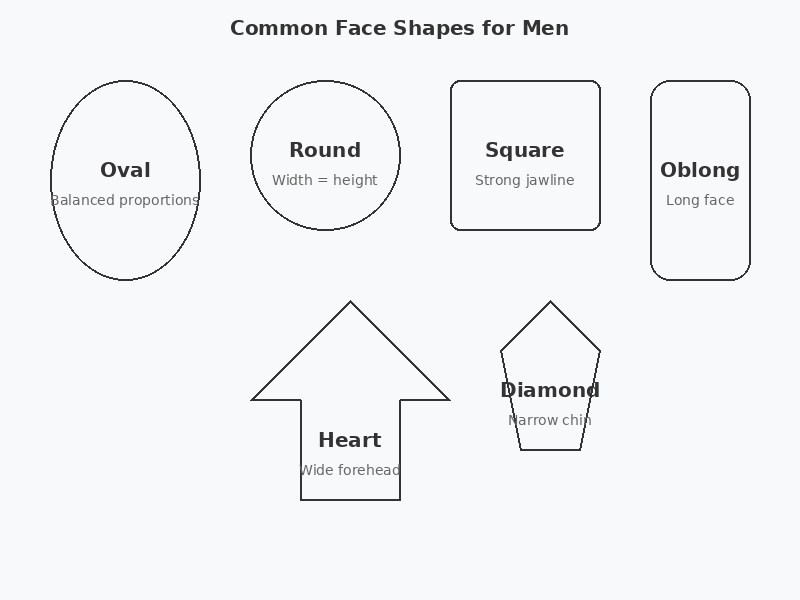
- Round faces: often the best case. Tight, high sides reduce width where a round face is widest, and a top with some height lengthens the face’s appearance. A high fade with a textured or brushed-up top is a strong choice here — the opposite advice from a soft, low taper.
- Square faces: works well and emphasises a strong jaw. If you want to keep the sharp, masculine read, choose the high fade; if you want to soften the angles slightly, a mid fade does that better.
- Oval faces: balanced enough for a high fade in almost any top pairing. Choose by hair type and maintenance appetite rather than face shape.
- Long or rectangular faces: use caution. A high fade plus height on top elongates an already long face, and very tight high sides make the head look narrower and longer still. If you want a high fade with a long face, keep the top short and flat (a crew or crop rather than a quiff) and consider a high taper rather than skin, so some side presence remains.
- Heart-shaped faces (wide forehead, narrow chin): a high skin fade can widen the upper silhouette further by exposing the widest part of the head. A mid or low mid fade usually balances this shape better.
Head shape matters as much as face shape with this cut. A high fade exposes the sides of the skull: flat spots, a prominent occipital bone at the back, and bumps all become more visible the higher and shorter the fade goes. A good barber will adjust the blend height slightly around those features; a mid fade hides more of them by default.
Who a high fade suits — hair types
- Straight hair: the cleanest canvas. A high fade blends smoothly and the top lies predictably. Fine straight hair should avoid pairing a high skin fade with a very short top if scalp show-through on top is a concern.
- Wavy hair: workable and popular, but the top needs enough length for the wave to form — usually at least a number 5 equivalent at the front. Our guide to the best fade haircuts for wavy hair compares fade heights specifically for wave patterns, and the broader best short haircuts for wavy hair guide covers the lengths that keep a wave visible. On the sides, a high fade actually helps wavy hair by removing the zone where waves puff out above the ears.
- Curly hair: a high fade is a classic pairing for curls, because it removes the sides’ bulk completely and lets the top’s curl be the feature. Keep the top long enough for the curl pattern to show, and expect the blend to need a barber comfortable with curly texture.
- Thick hair: a high fade removes a lot of bulk efficiently, which thick hair often needs. The risk is the top-heavy silhouette described above — ask for the corners to be debulked and blended.
- Fine or thin hair: be selective. Tight sides can make a thin top look fuller by contrast, which is a real benefit. But if thinning is advanced on top, a high skin fade can draw the eye to the contrast line. A high taper at a number 1, with a short textured top, is usually the safer version.
- Receding hairlines: a high fade does not hide a recession; the tight sides emphasise the hairline’s shape. Many men wear it confidently anyway with a short top. If your goal is to minimise the recession’s visibility, a lower fade and a forward-worn crop usually serve that goal better.
How to ask your barber for a high fade haircut
“High fade” alone leaves the bottom length, the top, the hairline finish, and the back all undecided. Use numbers and name each zone. This script covers it:
“I’d like a high fade. Start the fade high, around the temple / upper side, and take the bottom down to [skin / a 0.5 / a number 1]. On top, [a textured crop / a crew cut] — about [a number 6 / an inch] at the front, shorter toward the crown, point-cut for texture, not blunt. Blend the corners where the top meets the fade so there’s no shelf or heavy edge. [Natural hairline / a clean edge-up] at the front, and keep the neckline [natural / tapered]. Can you check the blend in natural light or with the chair turned before we finish?”
Four details do real work. First, the start height and the bottom number are stated separately, so “high” is not misheard as “skin.” Second, the top is given a length and a texture, not just “short on top.” Third, naming the corners prevents the top-heavy shelf that ruins high fades on thick and wavy hair. Fourth, the blend check matters more on a high fade than any other height, because the short blend zone shows a missed line more clearly.
Bring a photo — ideally two: one showing the side, where the fade height is actually visible, and one showing the top you want. A front-only photo hides the very thing you are asking for. And if your barber suggests dropping the start slightly to work around a bump, cowlick, or flat spot, that is usually expertise, not upselling a different cut: a fade placed a fraction lower in one zone can blend better than a rigidly high line.
How to style the top of a high fade
The sides of a high fade need no styling at all — that is part of its appeal. All the work, which should still be only a couple of minutes, is on top.
- Start on towel-dried, slightly damp hair. Product distributes evenly on damp short hair and sets as it dries. On bone-dry hair, matte products can sit visibly on the surface.
- Use a pea-to-fingertip amount. At short top lengths, more product does not mean more hold; it means weight, shine, and build-up. Warm it fully between your palms first.
- Work it through back to front first, then style front to back. The first pass coats the roots and underside; the second sets the direction — forward for a crop, up and back for a crew or quiff.
- Choose the product by finish, not habit. A matte paste is the default for a textured top: definition without shine. Our guide to the best pomade for men’s short hair explains when pomade’s neater finish suits a classic top instead — on a high fade, keep pomade light and water-based, because heavy shine on top against skin-tight sides can look greasy fast. The hub guide to the best hair products for men’s short hairstyles compares every category by hold and finish if you are choosing from scratch.
- Leave the fade alone. Do not apply product to the faded sides, and do not try to brush or train them. There is not enough length there to style, and product on near-skin hair just adds shine to the scalp.
- Refresh with water, not more product. On non-wash days, wet hands run through the top reactivate yesterday’s product. Stacking fresh product daily is what creates the dull build-up that makes short hair look dirty by day three.
Blow-drying is optional at these lengths. If you want lift at the front, dry on low-to-medium heat while lifting with your fingers, then apply a smaller amount of paste to the dried hair to set it. For a crop or crew top, air-drying is usually enough.
How often a high fade needs a trim
This is the trade you are making, and it should be explicit before you commit: a high fade is the fastest-growing-out common fade.
- High skin fade: looks sharpest for about 7–10 days. By week two the skin zone has grown to visible stubble and the high contrast softens noticeably. Most men who keep a high skin fade re-cut every 2 weeks, with 3 weeks as the outer limit before it reads as a different, grown-out cut.
- High fade to a 0.5 or number 1: slightly more forgiving — every 2 to 3 weeks keeps it clean.
- High taper fade: every 3 weeks is comfortable, because the softer finish grows out as a longer version of itself.
Between full cuts, a neckline and around-the-ear clean-up extends the tidy look by roughly a week. Our guide on how to maintain a fade between barber visits covers that two-week touch-up routine in full — what you can safely tidy at home and what to leave for the barber, which matters more on a high fade because a mistake in the blend zone has nowhere to hide.
Budget and schedule honestly: if a barber visit every two weeks does not fit your life, a low mid fade will look better on your actual three-to-four-week rhythm than a high fade worn grown-out for half of every month.
Common mistakes with high fades
Asking for “high” and meaning “skin.” Height and bottom length are separate. Men who ask only for a high fade and picture a skin finish — or the reverse — get a cut they did not intend. Name both numbers.
Pairing a high skin fade with a long, heavy top and no corner blending. The silhouette goes top-heavy within days as the top grows. The corners need blending and debulking at the cut itself.
Choosing a high fade to hide a hairline or head-shape feature it actually exposes. Tight high sides showcase the hairline, scalp, and skull shape. If concealment is the goal, a lower fade is the honest recommendation.
Judging the fade only under barber-shop lighting. Bright overhead shop light can hide a blend line that daylight shows clearly. Check the sides near a window or outside before you leave, especially the transition behind the ear.
Trying to fix a grown-out high fade with more product on top. Growth changes the sides, not the top’s styling. When the contrast is gone, the fix is a trim, not a stronger hold product.
Stretching a skin fade to a monthly rhythm. No styling routine keeps a high skin fade sharp for four weeks. Match the cut to the visit cadence you will actually keep.
Frequently asked questions
What is a high fade haircut?
A high fade haircut is a fade that starts blending high on the sides — around the temple and upper side of the head, near where the side meets the top — and transitions down to a very short length or skin at the bottom. It gives the strongest contrast between the sides and the top of any common fade height.
What guard length is a high fade?
“High” describes where the fade starts, not a single guard. The bottom is most often skin, a 0 to 0.5, or a number 1 (about 3 mm). The blend then works up through the half sizes to the top’s side length. Always state the bottom number separately from the word “high.”
Is a high fade better than a mid fade?
Neither is better in general — they suit different goals. A high fade is sharper, more modern, and higher maintenance, re-cut every two to three weeks. A mid fade is more balanced and forgiving of head shape and grows out more gracefully. Round and square faces often suit a high fade best; long faces usually suit a mid fade better.
How long does a high fade last?
A high skin fade looks its sharpest for about 7–10 days and usually needs re-cutting every 2 weeks, 3 at most. A high fade finishing at a number 1, or a high taper fade, stays tidy closer to 3 weeks. It grows out faster than low and mid fades because the shortest zone shows stubble quickly.
Does a high fade suit wavy hair?
Yes, with the right top length. Keep the top at roughly a number 5 equivalent or longer at the front so the wave can form, and let the high fade remove the puff that wavy hair builds above the ears. Very short tops on wavy hair lose the wave and read as texture only.
Should I get a high skin fade or a high taper fade?
Choose a high skin fade for maximum sharpness and contrast, accepting a trim roughly every 2 weeks. Choose a high taper fade for the same high silhouette with a softer, more natural edge, a more graceful grow-out, and a comfortable 3-week rhythm. For a first high fade, the taper version is the lower-risk trial.
What should I ask my barber for a high fade?
State the start height (“high, around the temple”), the bottom length (“down to skin / a 0.5 / a number 1”), the top length and texture (“textured crop, about an inch at the front, point-cut”), blended corners with no shelf, and your hairline and neckline preference. Bring a side-view photo, because fade height is visible from the side, not the front.
The bottom line
A high fade haircut works when you choose it for the right reasons — a round or square face, a wish for maximum contrast, and a schedule that allows a cut every two to three weeks — and when you ask for it in two numbers, not one word: high start, stated bottom length. Pair it with a textured crop or crew-length top, get the corners blended so the silhouette never goes top-heavy, style the top with a fingertip of matte product on damp hair, and leave the sides completely alone. If your face is long, your hairline is the thing you want to minimise, or your real barber rhythm is monthly, take the honest alternative and get the low mid fade instead — a slightly lower fade worn fresh looks better than a high fade worn grown-out. Either way, you now know exactly what to ask for, and what to check before you leave the chair.