

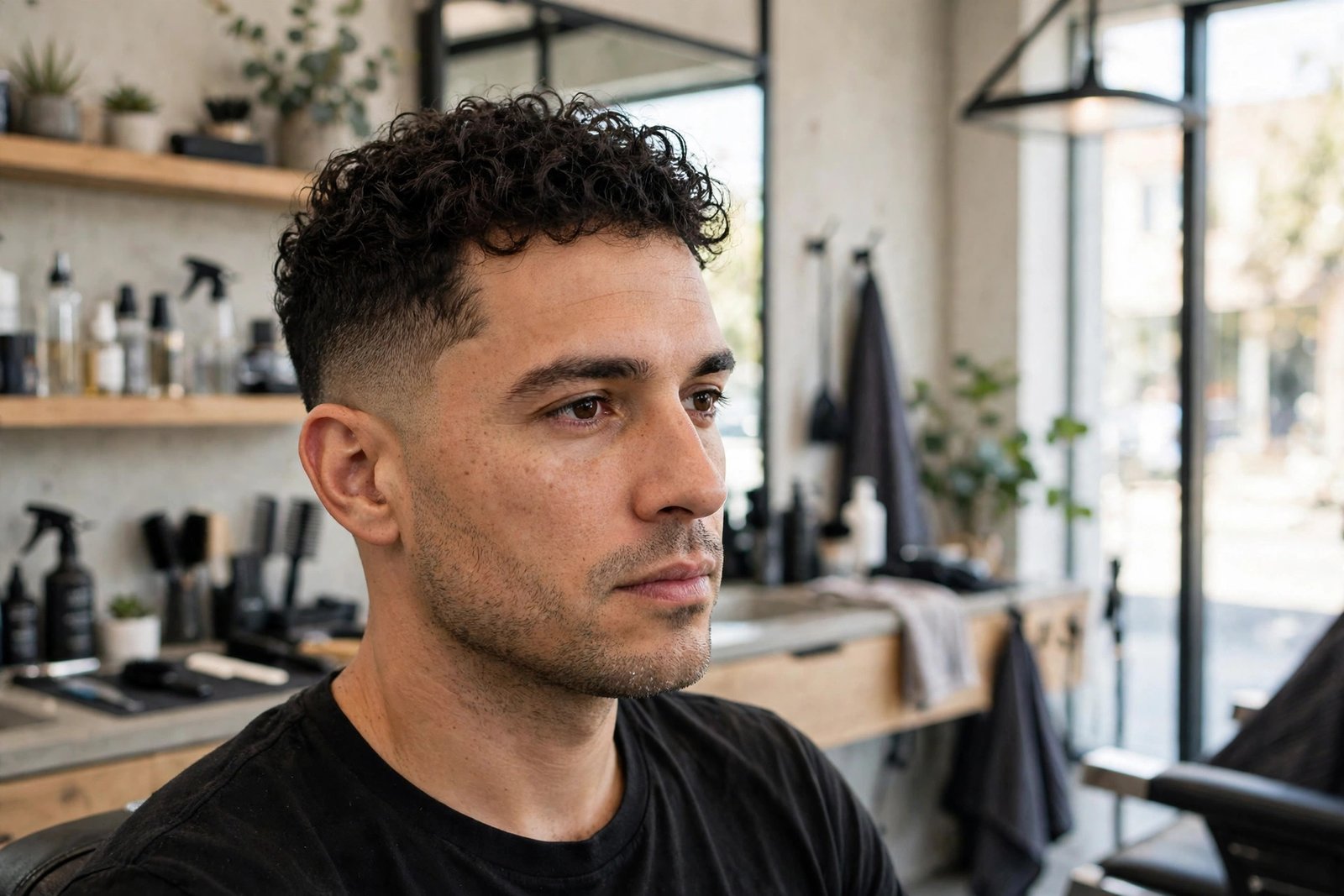
Curly hair plays by different rules than straight or wavy hair — and most “bad” curly haircuts are not bad cuts, just cuts that ignored how curls behave. A curl that measures 2 inches stretched out may sit at 1 inch dry. A blunt line that looks crisp on straight hair turns into a shelf on curls. And a fade that works on straight hair can expose the scalp in patches where curls clump.
This guide explains the six short cuts that work with curls rather than against them, how to ask your barber for each one, and the technique choices that decide whether the result looks intentional or accidental. If your hair is wavy rather than curly, the guide to short haircuts for wavy hair covers the lighter-touch version of the same problem.
First, understand what your curls actually do
Three behaviors explain almost every curly-haircut success or failure:
Shrinkage. Curls spring up as they dry, so wet length is a misleading guide. A cut that looks right when wet can sit an inch shorter dry. Barbers who cut curly hair well measure and finish on dry hair, or at least check the dry result before calling it done.
Volume direction. Curly hair expands outward and upward, not downward. Sides that are left too long puff out into a triangle; a top that is cut too short loses its shape and looks frizzy rather than defined. The goal is controlled volume on top and compressed volume on the sides.
Dryness and definition. Curly hair is usually drier than straight hair, because the scalp’s natural oils travel poorly around bends. Curls that are cut with blunt, heavy lines separate into chunks; curls cut with texture and point cutting clump into defined groups. The difference is the cut, not the product.
The 6 best short cuts for curly hair
1. Curly textured crop (French crop with curl)
The most reliable short curly cut. The top is left at 1–2 inches so the curls can form, the fringe is cut short and textured rather than straight across, and the sides are tapered short so the silhouette stays narrow. It works on loose and tight curls alike, needs almost no styling, and grows out without an awkward stage. Ask for texture on top, not a blunt fringe.
2. Tapered curls with a low fade
A low fade keeps the curls visible and defined while the sides stay clean. The fade starts just above the ear and blends into the curls gradually, so the contrast is gentle and the grow-out is forgiving. This is the best choice if you want a fade but do not want the curls buried under a high contrast cut. Our fade maintenance guide covers the weekly routine that keeps the edges sharp between visits.
3. Short curly afro (uniform length, shaped)
A shaped afro at 1–2 inches all over, rounded rather than boxy. The key is the shape: the barber picks the curls out and rounds the silhouette so it reads as deliberate, not overgrown. It suits tight curls and coils best, and it hides thinning better than most cuts because the volume is even. Keep the neckline clean and the edges defined.
4. Curly quiff with tapered sides
For looser curls and waves that have enough length to sweep up. The top is left at 2–3 inches, the sides are tapered (not faded to skin), and the curls are styled up and back with a light cream or sea salt spray. It needs a little morning effort, but it is the most versatile curly cut: it can be worn forward as a crop or swept back as a quiff.
5. Buzz cut for curly hair (with a warning)
A buzz works on curly hair — but it behaves differently than on straight hair. A #2–#4 guard leaves enough length for the curl pattern to show as texture rather than frizz; a #0–#1 can look patchy while it grows out, because curls grow at slightly different rates. If you are considering it, read our buzz cut guide first, and ask your barber about a uniform #3 rather than going straight to the shortest guard.
6. Curly fringe with a mid taper
A fringe worn forward with a mid taper on the sides — the curls at the front do the styling for you. The fringe should be cut with texture and left long enough to curl, not cut straight across. The mid taper keeps the sides tidy without the high contrast of a skin fade. Best for men whose curls fall naturally toward the forehead.
Cut comparison: lengths, upkeep, and who each suits
| Cut | Top length (dry) | Sides | Barber visit cycle | Best for |
|---|---|---|---|---|
| Curly textured crop | 1–2 inches | Tapered | Every 3–4 weeks | Most curl types; lowest effort |
| Tapered curls, low fade | 1.5–3 inches | Low fade | Every 2–3 weeks | Defined curls with clean sides |
| Short curly afro | 1–2 inches | Shaped, same length | Every 3–4 weeks | Tight curls and coils |
| Curly quiff | 2–3 inches | Tapered | Every 3–4 weeks | Looser curls; versatile styling |
| Buzz cut (#2–#4) | 1/4–1/2 inch | Same guard | Every 2–3 weeks | Lowest maintenance; even texture |
| Curly fringe, mid taper | 1.5–2.5 inches | Mid taper | Every 3–4 weeks | Curls that fall forward |
How a curly cut should be executed (what to ask your barber)
The same requested cut can succeed or fail on technique alone. Three things worth specifying:
Cut it dry, or at least finish it dry. If the barber cuts your hair soaking wet, the result will shrink unpredictably. A good curly cut is checked and finished on dry hair, with the curls in their natural position.
Point cutting and slicing instead of blunt lines. Blunt cutting across a curl creates a hard edge that separates into chunks. Point cutting (snipping into the ends at an angle) and slicing remove weight without creating lines, so the curls clump naturally.
No thinning shears on tight curls. Thinning shears cut some strands shorter than others, which makes tight curls frizz and lose definition. If the barber wants to remove bulk, they should use point cutting or a scissor-over-comb technique, not thinning shears.
Expect to pay $25–$45 for a curly cut at a good barber — the dry cut and finishing take longer than a standard clipper cut, and that time is the difference between a cut that works and one that puffs out. Bring a photo, and state your maintenance level honestly: “I want to spend two minutes on this in the morning” is useful information.
Styling curly short hair without fighting it
Curly short hair needs less styling than most men expect, but it needs the right kind. The mistake is treating it like straight hair: combing it flat, blow-drying it straight, or loading it with heavy product. All three fight the curl pattern and make it look worse.
A simple routine:
- Apply product to wet hair. Curl cream or a light leave-in conditioner, worked through with your fingers while the hair is damp, defines the curls before they set.
- Scrunch, don’t comb. Push the curls up toward the scalp with your hands. A comb pulls the curls apart and creates frizz; scrunching keeps the clumps together.
- Air-dry or diffuse on low heat. High heat and fast airflow blow the curls apart. Low heat with a diffuser, or simply air-drying, preserves the pattern.
- Refresh, don’t rewash. On day two, dampen the hair lightly and re-scrunch rather than washing and starting over. Curly hair holds its shape better on the second day.
That is the full kit: a curl cream or leave-in, and optionally a sea salt spray for looser curls that need texture. Avoid heavy waxes and pomades — they weigh curls down and make them look greasy. If you need hold, a light cream or a matte clay used sparingly works better than a strong wax. For the full picture, see our clipper guard sizes guide before choosing a guard length for the sides, and our complete guide to men’s short hairstyles for how curls fit into the wider choice of cut.
Mistakes that ruin curly cuts
- Cutting it wet and short. Wet curls stretch; the cut ends up shorter than planned once dry. Always leave a margin.
- Blunt lines across the curl. A straight fringe line or a hard weight line separates curls into chunks. Texture and point cutting are the fix.
- Sides left too long. Long sides on curly hair puff outward into a triangle. Keep the sides short and tapered.
- Thinning shears on tight curls. They create frizz and uneven lengths. Ask the barber to use point cutting instead.
- Over-washing and over-combing. Daily shampoo strips the oils curly hair needs; combing dry curls breaks the clumps apart. Wash 2–3 times a week and style with your fingers.
Frequently asked questions
How short is too short for curly hair?
Below about 5/8–1 inch, most curl patterns disappear and the hair reads as texture rather than curls. That is fine if a buzz is what you want, but it is too short if you wanted visible curls. For defined curls, keep at least 1 inch on top when dry.
Do I need a special barber for curly hair?
Not a specialist, but a barber who is comfortable cutting dry and using point cutting rather than clippers-only work. Ask whether they cut curly hair dry — if the answer is a confident yes, you are in the right chair.
Will a fade work with my curls?
Yes — a low or mid fade pairs well with curls, because the short sides contrast with the defined top. A skin fade is the riskiest option: the sharp line can expose patchiness where curls clump. Start with a low fade and go higher only if you like the result.
How often should curly hair be cut?
Every 3–4 weeks for most short curly cuts; every 2–3 weeks if you have a fade, because the fade line blurs fastest. Curls hide growth better than straight hair, so you can stretch a taper a week longer than a fade.
Can I use regular shampoo on curly hair?
Yes, but wash less often — 2–3 times a week is enough for most men — and consider a conditioner or leave-in. Curly hair is drier by nature, and daily shampooing makes it frizzier and harder to define.
What is the best product for short curly hair?
A curl cream or light leave-in conditioner for definition, and a sea salt spray if your curls are loose and need texture. Avoid heavy waxes and high-shine pomades, which weigh curls down and make them look greasy rather than defined.
The short version
Curly hair is not difficult hair — it is hair that punishes cuts made for straight hair. Keep the top long enough for curls to form, keep the sides short and tapered, cut it dry with point cutting, and stop fighting the pattern. Do that, and the curls do most of the work themselves.

